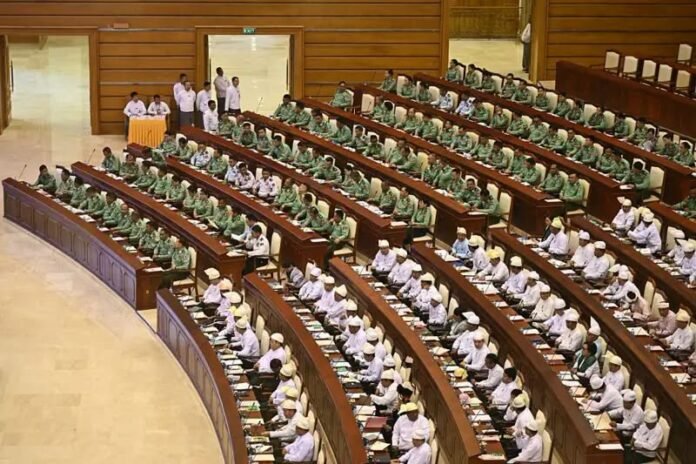
The military government has been gradually imposing stricter regulations on political party representatives seeking to contest elections and enter legislative bodies or government administration.
A draft law submitted by the military government to the Pyidaungsu Hluttaw proposes that candidates running in elections must now hold a university-level degree to be eligible to contest parliamentary seats.
The draft law also states that even if a candidate has already been elected, the Election Tribunal may determine that they are no longer eligible to serve as a parliamentarian if they fail to submit election expense reports in accordance with required regulations.
Furthermore, the new law includes a provision stating if the political party, a representative belongs to, has its registration cancelled, the elected representative will automatically lose their status as a member of parliament.
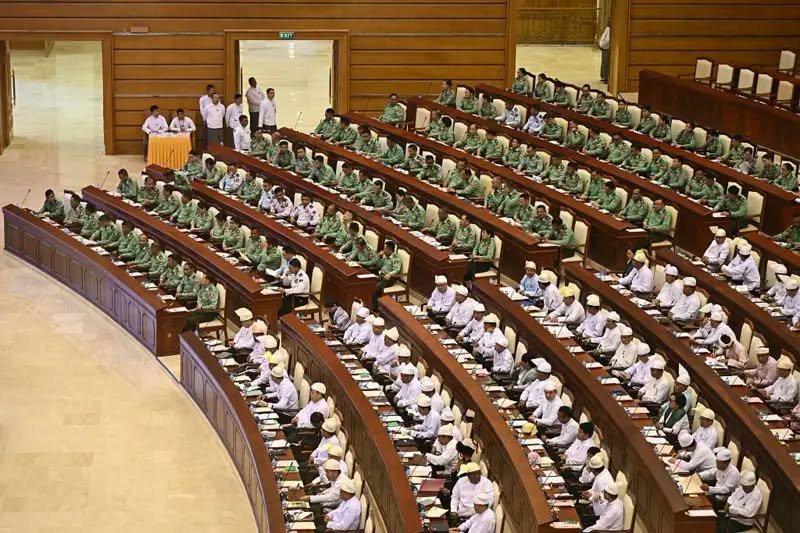
However, it is reportedly possible for the representative to continue serving as a parliamentarian under a different political party if they submit evidence of membership in that party and apply to the Union Election Commission (UEC) within 60 days from the date their original party is dissolved or deregistered.
A current member of the military government’s Pyithu Hluttaw said: “It feels like they are effectively telling us not to engage in politics. We have to follow every rule issued by the UEC. If you look at the previous election, parties had to raise funds, recruit members, and meet various requirements. Some parties were dissolved because they failed to meet those conditions. If we are being honest, there were times when we had to focus simply on having enough party members to meet the requirements. Now, it feels like we are just following the rules they set.”
During the military-organized 2026 election process, several parties — including the National Democratic Force Party (NDF), Democratic Party of National Politics (DNP), Women’s Party (Mon), and Union Farmer-Labour Force (UFLF)— were dissolved for failing to meet requirements related to party offices and membership numbers.
The chairperson of the Union Election Commission (UEC), former Brigadier General Than Soe, was directly appointed by junta leader, Min Aung Hlaing.
During meetings between the military and political parties, discussions were also held on extending the term of the Election Commission to 10 years.
In addition, agreements were reportedly reached to introduce laws preventing parliamentary representatives and Union ministers from having foreign influence, with restrictions also applying to their family members, including children, spouses, daughters-in-law, and sons-in-law.
A political analyst commented: “This means that even if politicians who left the country after 2021 return, they will no longer be able to become ministers or deputy ministers. They will not be able to hold senior government positions. This targets those who sought refuge in other countries after the coup. The implication is that only people who are acceptable to the military and aligned with them will become government officials and hold influential positions.”
Retired military personnel and individuals who entered politics with the support of military leaders have secured positions within the military-backed Union Solidarity and Development Party (USDP) and have won seats in elections organized by the military.
Although junta leader Min Aung Hlaing continues to claim that he will establish a democratic system, current actions on the ground indicate attempts to manipulate laws in order to maintain military influence in the political sphere.