Written by Mehm Sahai
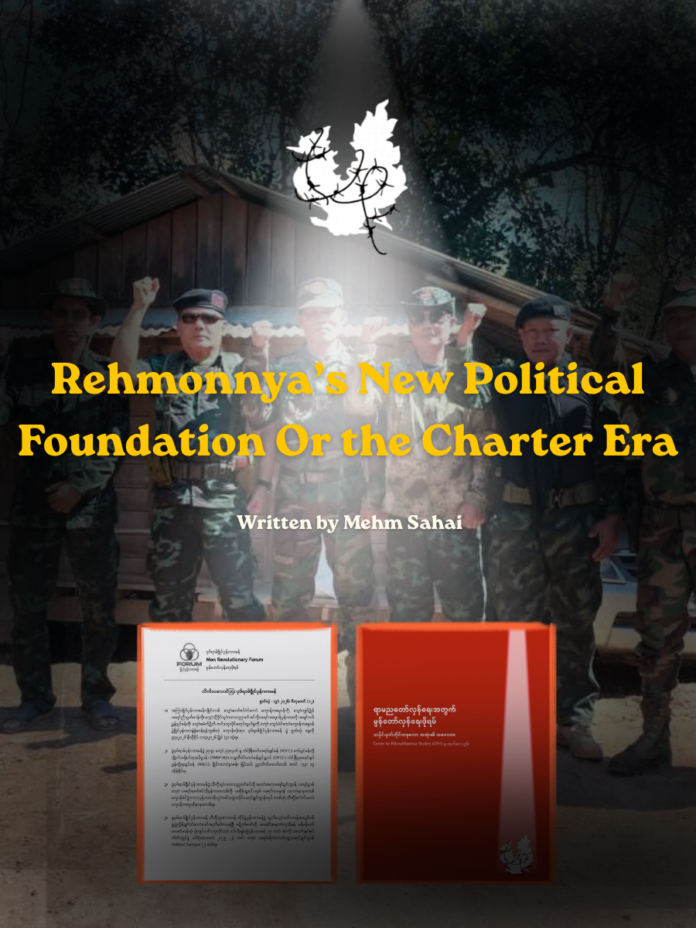
The long-imagined Constitution of Rehmonnya Mon State, has been discussed for decades, but never realized. Instead, revolutionary forces are now drafting what is being called a Charter. According to a report by the Center for Rāmaññadesa Studies (CRS), the Mon Revolutionary Forum held in March 2026, marked a significant turning point in the political landscape of Rehmonnya.
The forum’s main outcome was the acceptance of the “Mon State Revolutionary Charter” as a common political framework bringing together the New Mon State Party (Anti-Military Dictatorship) (NMSP-AD), the Mon State Federal Council (MSFC), and other revolutionary forces.
Mon revolutionary groups fighting against military dictatorship also agreed to reject any administration or election conducted under the 2008 Constitution. This move directly challenges the political legitimacy of the military junta in the Rehmonnya region and establishes a clearer political direction toward building a federal democratic unit.
Building a Single Command Structure
Regarding the current military situation, the report noted that Mon revolutionary forces still face weaknesses in territorial control and governance mechanisms compared to neighboring groups such as the Karen National Union (KNU) and the Interim Executive Council (IEC) of Karenni State.
To overcome these weaknesses, the report stressed the need to unify armed groups under a single command structure known as the “Ramanya Revolutionary Army.”
According to the report, military and administrative integration is essential for the emergence of a revolutionary government. The “Joint Coordination Working Group” formed during the forum is attempting to unite different armed organizations under the common charter framework, which could become a practical step toward security and stability in the Rehmonnya region.
Three Possible Future Scenarios
The report also outlined three possible scenarios for the future of the Mon revolution, which could shape the direction of revolutionary forces.
Baseline Scenario
Under this scenario, a revolutionary government based on the “Mon State Revolutionary Charter” would emerge. Led by the MSFC and NMSP-AD, the government could establish limited territorial control in southern Mon State and northern Tanintharyi Region.
However, because not all revolutionary groups would be included, there could still be weaknesses in ethnic representation. The military junta’s administrative system would also remain partially in place, creating a situation of competing control.
Worst-case Scenario
In this scenario, disagreements among revolutionary forces over power-sharing, resources, and territorial boundaries would intensify.
The report warned that revolutionary groups could begin prioritizing their own organizational interests over the broader revolutionary goal, potentially leading to internal conflict. In such a situation, the military junta could intervene under the pretext of “peace” or fake ceasefire negotiations to divide the revolutionary movement.
Best-case Scenario
Under the best-case scenario, all revolutionary forces would fully unite under the “Mon State Revolutionary Charter.”
A unified military command structure, such as the “Ramanya Revolutionary Army,” would emerge and successfully remove the military junta’s political and military presence from Rehmonnya territory.
If achieved, Mon State could stand as a dignified federal unit within a future federal union.
The report noted that these possible outcomes will depend largely on the practical actions of revolutionary organizations and could help political actors prepare for future regional developments.
Southern Revolution and the Role of Rehmonnya
The report also highlighted that the Mon revolution is not an isolated movement. It is developing alongside regional political changes, including the KNU’s adoption of its own charter and the formation of the Dawei Army.
The document serves not only as a record of the Mon revolutionary process but also as a roadmap for building a revolutionary government and delivering public services in the future.
Conclusion
The report recommended that Mon revolutionary forces focus more on local governance and public service delivery in order to gain public trust and international recognition.
It concluded that the key challenge for the Mon revolution is not historical pride alone, but whether it can effectively manage the political realities of the present time.
The report may serve as a roadmap for the Mon revolution, but it is ultimately the responsibility of Mon revolutionary forces to walk that path. With the political stakes in Rehmonnya now very high, every wrong step could become a historical regret in the future.
Reference: “Mon Revolutionary Forum for the Rehmonnya Revolution” report by the New Rehmonnya Federated Force (NRFF) and the Center for Rāmaññadesa Studies (CRS).