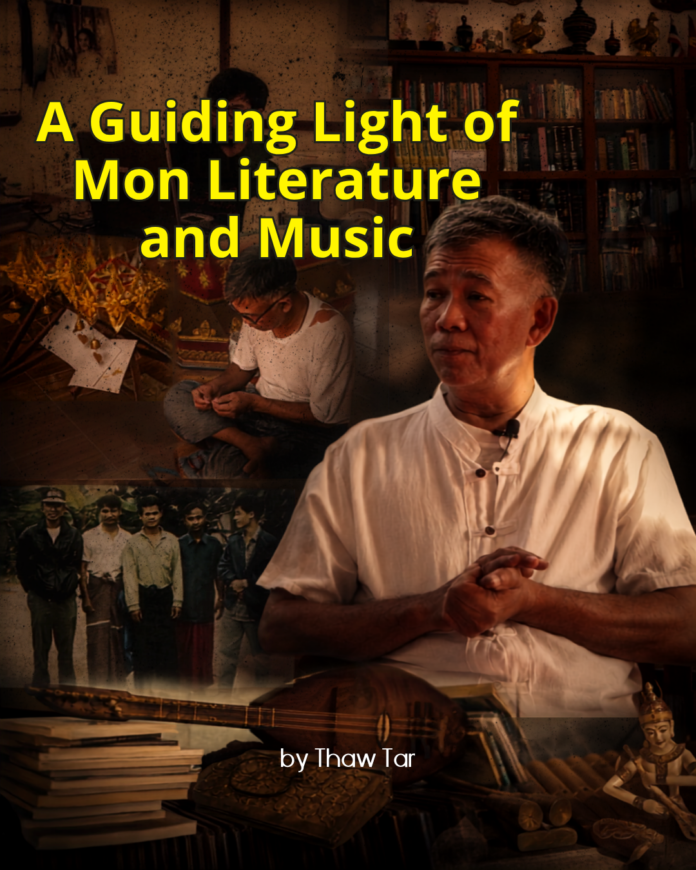
Profile by Thaw Tar
“If out of 1,000 copies of my books, only ten people read them, and those ten truly understand what they have read, I am satisfied. That alone is enough to ensure that Mon history will endure for future generations.”
These words reflect the heartfelt conviction of a literary researcher who believes that preserving Mon literature and history is not about reaching the largest audience, but about fostering lasting understanding.
Since the fall of the Mon Kingdom, the Mon people’s literature, language, culture, and artistic traditions have endured centuries of suppression and destruction. There was even a time when Mon families no longer had traditional Mon lullabies to sing to their children—a poignant reminder of how deeply their cultural heritage had been eroded.
Amid such losses, dedicated enthusiasts, cultural advocates, and lovers of Mon literature and music have worked tirelessly to rediscover, document, and preserve what remained of their heritage, even without formal academic training.
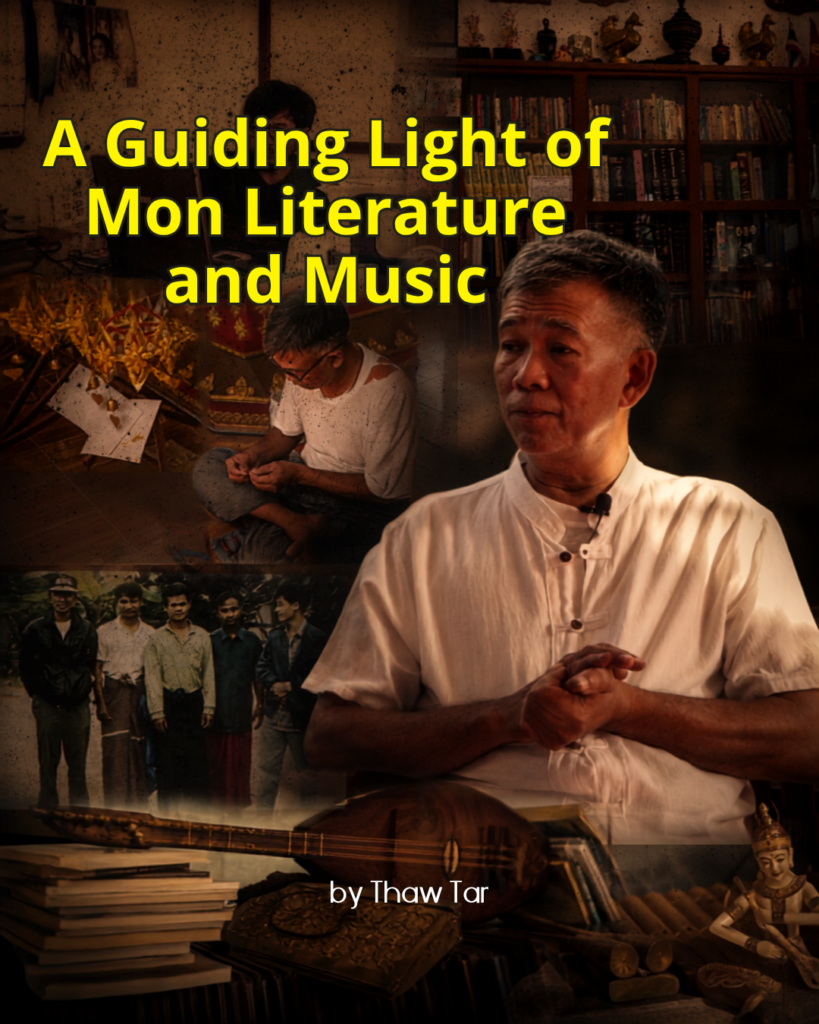
Among these individuals is Nai Ork Pung, a literary researcher from Ye Township who has devoted himself to the study of Mon literature, traditional Mon music, and cultural history. Alongside his regular profession, he has spent years conducting field research among Mon communities in Thailand and Mon villages in Myanmar, collecting cultural traditions and musical knowledge that have become increasingly difficult to find.
Today, he is widely recognized as one of the leading figures in Mon literary and musical circles, known for his continuous publication of research on Mon literature and traditional Mon music.
A lifelong passion for literature
His love of literature began during his childhood as a novice monk. As a young man, while earning a living as a mason in present-day Lamaing, about three miles from his native village, he actively participated in Mon literary, cultural, and youth organizations.
During Myanmar’s 1988 nationwide pro-democracy uprising, he and his friends took an active role in the student-led movement against military rule.
After the military violently suppressed the democratic movement, tens of thousands of students fled to resistance-controlled areas. He and his companions eventually reached the headquarters of the New Mon State Party (NMSP).
While serving in the NMSP, he worked in the party’s organizing, international relations, and relief departments. At the same time, together with literary figures Nai Thet Lwin and Nai Kasauh Mon, he continued pursuing their shared passion for literature and cultural preservation.
In 1993, he and his close friend Nai Thet Lwin—the compiler of the Mon-Myanmar Dictionary—left the party together. They settled in Sangkhlaburi on the Thai-Myanmar border, where he remained actively involved in Mon community organizations.
From poetry to research
Although he had written poems and songs whenever inspiration struck, it was only after 2000 that he began publishing books in a more systematic way.
“I started by writing songs and poems. I wrote quite a lot. Before I joined the New Mon State Party, I had already been collecting literary materials. That allowed me to publish my first book on music research in 2000.”
Drawing upon research materials and historical records collected over many years, he produced his first scholarly work on Mon music. Among his most well-known publications are Research on Mon Literature Across Three Historical Periods and Research on Mon Classical Traditions.
Today, he continues to collect historical documents throughout Thailand and Myanmar while working to transcribe ancient Mon palm-leaf manuscripts into modern printed texts.
Recognizing that many of his research books are challenging for younger readers, he also welcomes young writers who are interested in adapting his work into more accessible language while preserving its original meaning.
An artist beyond literature
His talents extend well beyond scholarship. Uttara-Sūḷadīpa is also highly skilled in the traditional crafts of painting, sculpture, and traditional architectural craftsmanship.
Artistry runs deep in his family. His maternal grandparents were masters of the Ten Traditional Crafts, including painting, sculpture, and traditional architectural craftsmanship. They were also accomplished musicians who handcrafted a wide range of Mon musical instruments, carefully carving and tuning each one to produce the finest possible sound.
Although he was fortunate enough to learn these artistic traditions directly from his grandparents, he speaks with sadness about how few members of the younger generation within his own family have inherited these skills.
“Our grandparents were deeply worried that these traditional skills would disappear. Sadly, today there are hardly any descendants left who have mastered them.”
Preserving language for future generations
He is equally concerned about the future of the Mon language. He observes that fewer young people are prioritizing Mon literature, and even spoken Mon has begun to lose aspects of its traditional pronunciation.
“Young people are no longer pronouncing certain Mon sounds correctly. For example, the word ‘daam’ (the M sound) should be pronounced with closed lips, but many now pronounce it with their mouths open. These kinds of changes are gradually affecting the language.”
Because debates about Mon history often arise within the community, he consistently encourages people to read his book Research on Mon Literature Across Three Historical Periods, believing that careful research can help deepen understanding of their shared past.
A life devoted to art
He once summarized his life’s journey with remarkable simplicity: “Nothing in my life means more to me than music and art. Literature and music make me forget everything else—even food.”
True to those words, he continues to dedicate himself to the world of Mon literature and music—writing, researching, creating, and preserving the cultural heritage he cherishes.
Through his lifelong commitment, he has become not only a researcher and artist, but also a guiding light whose work helps ensure that the language, history, and artistic traditions of the Mon people continue to live on for generations to come.