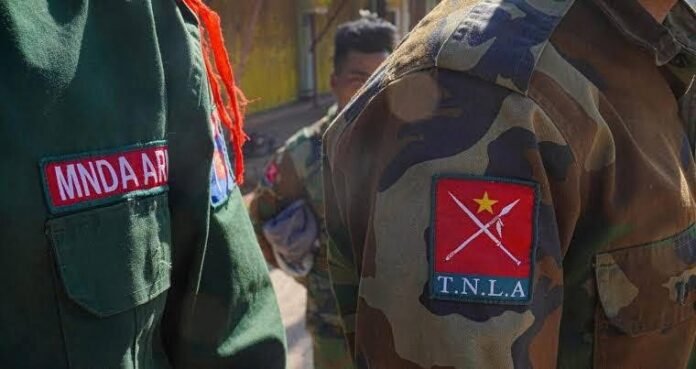
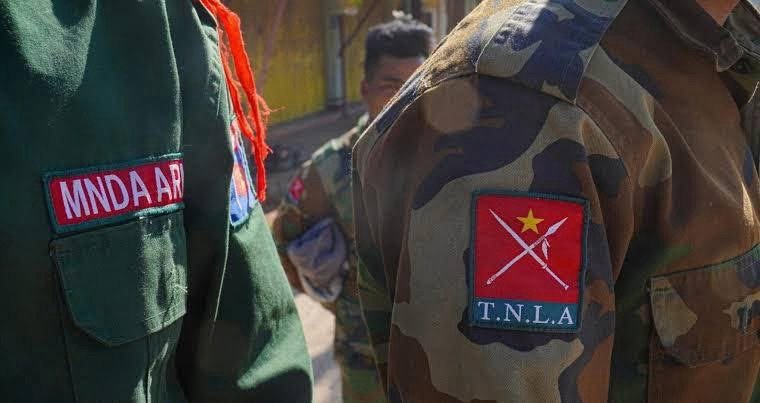
Six Ta’ang civil society organizations have called on the Ta’ang National Liberation Army (TNLA) and the Kokang-based Myanmar National Democratic Alliance Army (MNDAA) to immediately cease fighting in northern Shan State and resolve their disputes through dialogue, at the negotiating table, in order to maintain regional peace and stability.
The conflict reportedly began on February 13th in Kutkai, when TNLA forces removed CCTV cameras installed by the MNDAA along the Union Highway, escalating tensions between the two sides and eventually leading to armed clashes.
At present, MNDAA forces have taken control of a TNLA strategic hill base in Kutkai, forcing TNLA troops to withdraw from the town.
According to Aik Mun from the Ta’ang (Palaung) National Party (TNP), the fighting has spread beyond Kutkai to areas including Namkham and Namhpakka.
“Right now, heavy fighting is taking place around the 12-mile and 13-mile areas near Namkham and Namhpakka, particularly around a micro tower. Clashes are also occurring in Ta’ang villages such as Man Aung, as well as Panhsay, Panmai, and Panmaw,” he said.
A politician from northern Shan State claimed that the clashes between the TNLA and MNDAA are due to China giving the green light as part of its effort to dominate and control Myanmar.
“This doesn’t even need much explanation. Things are going according to China’s plan. People may not say it openly, but we have long felt uneasy about China’s attempts to dominate Myanmar. It’s been happening for a long time. What they are doing is part of a broader effort to take over the country. They find various justifications and exploit instability for their own benefit. If China had not given the green light for Kokang, it would not have happened,” he said.
He added that it is possible China allowed the MNDAA—considered closer to Beijing—to take control of Kutkai, which had previously been held by the TNLA during Operation 1027.
Kutkai lies along a key Union highway and holds strategic importance. Similarly, Namhpakka is also strategically significant, as control of Namhpakka provides leverage over Namkham. Political analysts say the MNDAA is attempting to secure dominance over these areas.
Aik Mun from the TNP also stated that China’s involvement has contributed to escalating tensions between the allied TNLA and MNDAA.
Civil society groups further urged both sides to immediately halt actions that could lead from military conflict to ethnic conflict, and instead focus on dismantling authoritarian rule.
Although both the TNLA and MNDAA have expressed willingness to resolve the conflict through negotiations, clashes continue to intensify on the ground.
The National Unity Consultative Council (NUCC) and the Spring Revolution Alliance (SRA) have also called on both groups to engage in dialogue and find a peaceful resolution.