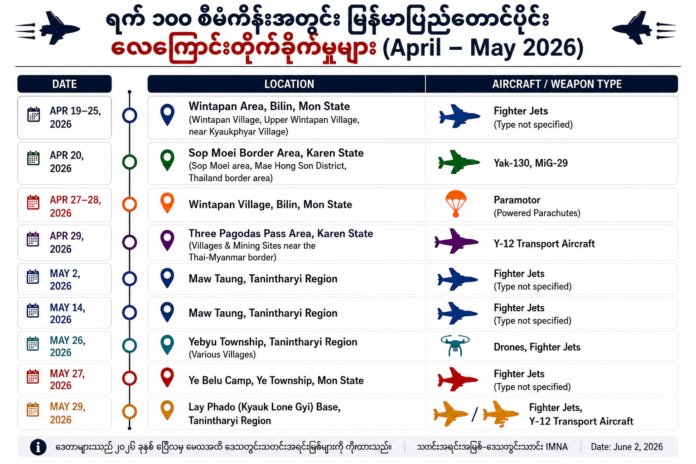
Airstrikes by Myanmar’s military junta have intensified across southern Myanmar, particularly in Mon State, Karen State, and the Tanintharyi Region, during the period of the regime’s so-called “100-Day Plan.”
The military authorities announced that, as a first step in their strategy, they would invite Ethnic Revolutionary Organizations (EROs) to pursue peace during a 100-day period running from April 20 to July 31.
However, at the same time, the junta has continued to threaten EROs and the People’s Defense Forces (PDFs), demanding that they surrender their weapons. On the ground, military operations involving airstrikes and artillery shelling have also been escalating on a daily basis.
The air attacks have targeted not only areas believed to host resistance bases and locations where fighting is taking place, but also civilian villages where no clashes have been reported.
According to Nai Aue Mon from the Human Rights Foundation of Monland (HURFOM) “From what we can see, the military has been increasing its use of weapons and troops to suppress civilians. Their primary objective is to retake areas they have lost. Regaining control of these territories has always been part of their plan, and they aim to reestablish their authority there. During this 100-day period, they have essentially been killing people and committing serious human rights violations. What they say and what they do are completely different.”
He added that the junta is attempting to regain control of territories lost in recent years, including certain areas under the control of the Karen National Union (KNU), trade routes along the Thai-Myanmar border, townships in the Tanintharyi Region along the Ye–Dawei road, and areas in Mon State where resistance groups are active.
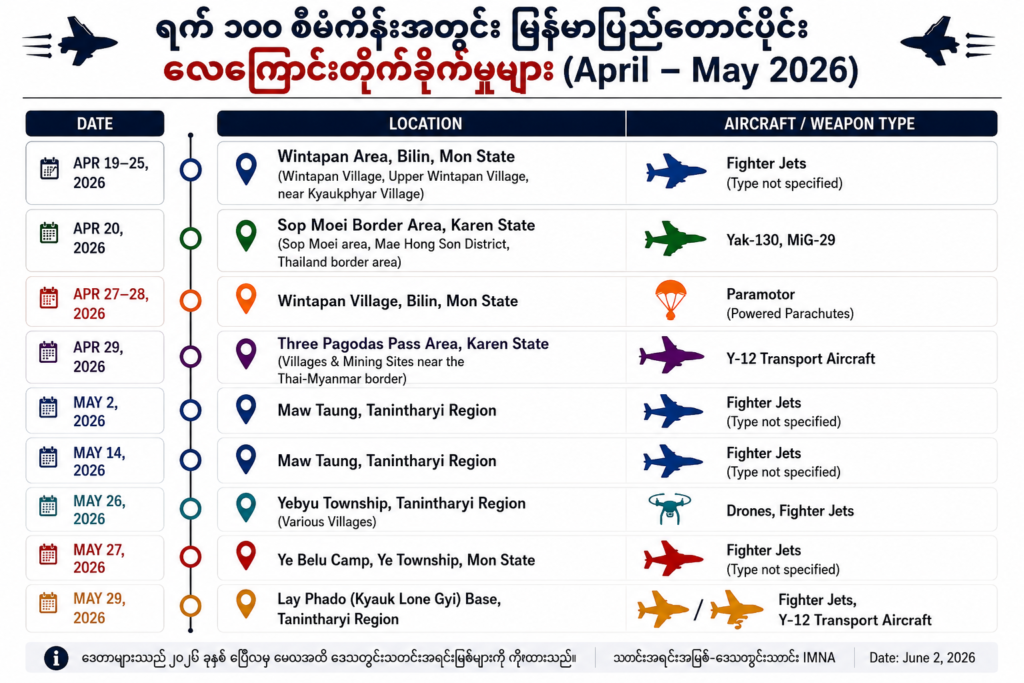
According to data collected by IMNA, between April 20 and the end of May—a period of more than 40 days—the military carried out at least 11 aerial bombing attacks in Mon State, including an airstrike on the Yebilu military base.
In addition, by the end of May, the military had conducted two airstrikes on mining sites near Three Pagodas Pass in Karen State. It also launched at least four drone and air attacks targeting villages in Maw Taung and Yebyu Township in the Tanintharyi Region, near the Thai-Myanmar border.
Min Yote Sanon, spokesperson for the Mon Blood Army, assessed that these airstrikes are part of a military campaign designed to pressure resistance forces into surrendering during the junta’s 100-day initiative.
“The purpose is to force revolutionary groups to surrender and enter the regime’s fold. It is a threatening military operation intended to send the message that if they do not surrender, even harsher attacks will follow. But no matter how much they threaten, no revolutionary organization will surrender. The regime continues to spread false reports claiming that this or that group has laid down its arms, but on the ground nobody pays attention to such claims, and nobody trusts them.”
The air campaign has continued into June. The military has reportedly carried out additional bombing attacks in areas bordering Mon State and the Tanintharyi Region, forcing residents of the upper Ye River area and Yebyu Township to flee their homes in search of safety.
Although direct clashes between armed groups decreased across Mon, Karen, and Tanintharyi regions in May 2026, civilians remain highly vulnerable. According to a May report by the Southern Myanmar Humanitarian Network, the region is facing one of its worst situations in terms of public safety, livelihoods, economic conditions, and overall security.