Despite having established a military government after the coup, Myanmar’s junta continues to face diplomatic isolation from both the international community and ASEAN.
However, during junta leader Senior General Min Aung Hlaing’s visit to China, Chinese President Xi Jinping openly declared that China would support the military government at both the United Nations and within ASEAN.
Although Min Aung Hlaing seized the country’s highest authority after the coup, the junta’s lack of international legitimacy has remained one of its greatest setbacks. At the United Nations, the military government’s appointed ambassador has not been recognized. Instead, the UN continues to recognize Myanmar’s Permanent Representative, Ambassador Kyaw Moe Tun, who has sided with the Myanmar people.
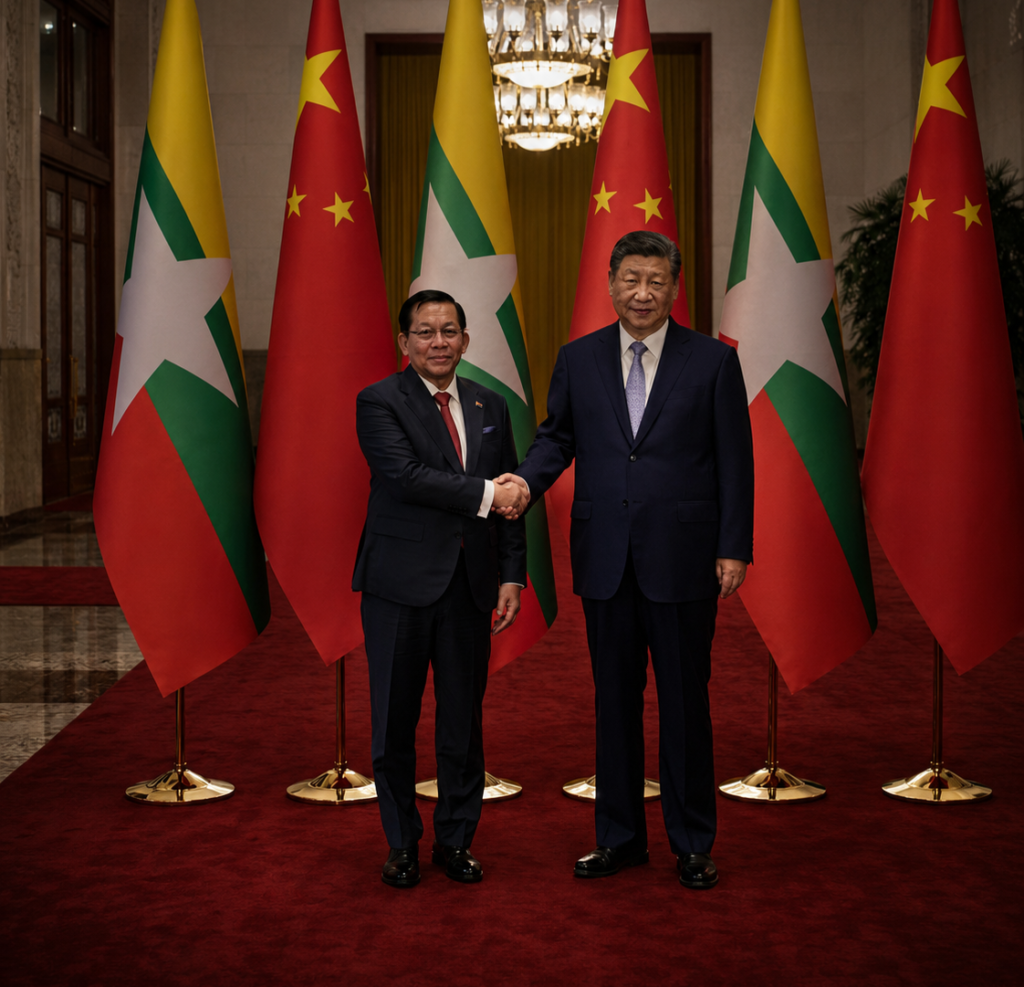
Similarly, the Association of South East Asian Nations (ASEAN) has barred Min Aung Hlaing from attending ASEAN Summit meetings and has denied Myanmar the opportunity to assume the bloc’s rotating role as Chair. However, analysts believe that China’s increasingly open support for the junta could reshape its diplomatic standing in the coming years.
U Win Min, Director of the Forum of Federations and an ASEAN affairs expert, commented: “To be honest, this can be seen as a policy shift, and it is one that deserves close attention. Within the ASEAN, there have already been discussions about changing the current approach. Some member states have proposed engaging directly with Myanmar’s military government to seek solutions to the crisis. The conflict has dragged on for far too long and is affecting regional development. There is growing recognition that the current policy cannot continue indefinitely and that adjustments are necessary. These changing views could become more influential at future ASEAN summits.”
China is one of the five permanent members of the United Nations Security Council with veto power and has consistently taken a public stance in support of Myanmar’s military authorities during UN deliberations.
Although the ASEAN continues to prohibit the military government led by Min Aung Hlaing from participating in its high-level summits, individual member states have maintained bilateral engagements with the junta.
Government officials from Thailand, Malaysia, Indonesia, Laos, and the Philippines have traveled to Naypyidaw for discussions concerning Myanmar’s possible reintegration into the ASEAN. Nevertheless, the military government backed by China remains dominated by the same senior generals who led the coup.
Min Aung Hlaing himself assumed the presidency without resigning from his role as Commander-in-Chief to contest an election.
A Myanmar political analyst observed: “The entire political arrangement was shaped by China—it is essentially the scenario China wanted. For nearly two years, China largely watched developments in Myanmar before becoming more directly involved. It was China that pushed for the election process, and the military followed its lead. China wants a government in its neighboring country that it can engage with officially while protecting its own strategic interests. Therefore, China will likely continue working to secure international legitimacy for the junta.”
In return for supporting the junta’s quest for international legitimacy, China expects progress on several of its strategic interests in Myanmar. These include the rapid implementation of Belt and Road Initiative projects, the reopening of cross-border trade, expanded development of electricity, oil, and natural gas projects, and guarantees for the security of Chinese investments. President Xi reportedly instructed Min Aung Hlaing to ensure the protection of these projects.
For his part, Min Aung Hlaing said that regional stability is essential for implementing these projects and expressed his willingness to cooperate closely with the Chinese government to move them forward.
As a result, analysts believe that following the China visit, Beijing may increase pressure on northern ethnic armed organizations to engage in peace negotiations. China’s role now appears to extend beyond providing diplomatic backing for Myanmar’s military leaders on the international stage; it is also seen as helping the junta manage domestic challenges in ways that protect Beijing’s strategic interests.