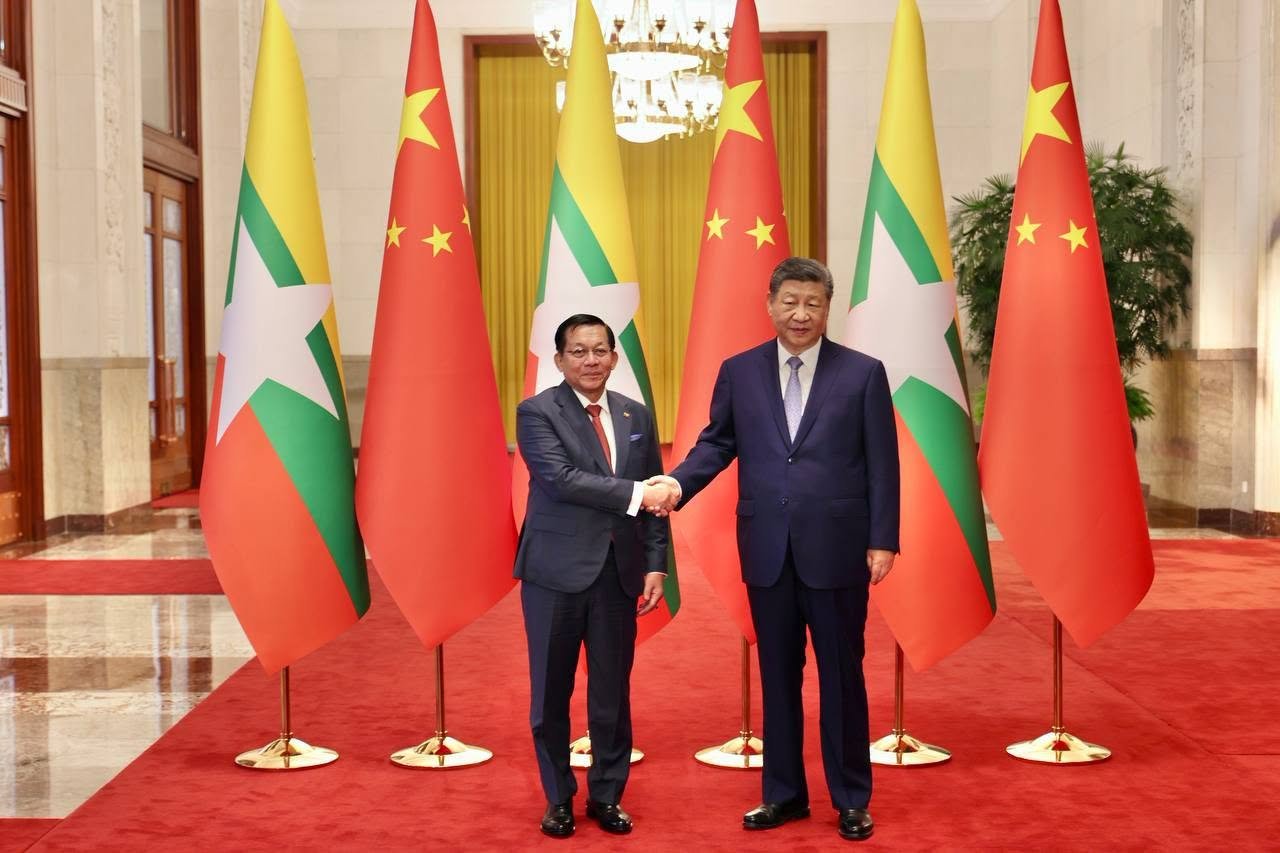
The coup leader, Min Aung Hlaing is currently on a five-day visit to China from June 15 to June 19.
Observers of the trip are suggesting that various forms of pressure may soon be exerted on revolutionary forces, including armed groups operating along the China–Myanmar border, in coordination with Beijing.

“There are revolutionary forces along the China border—meaning groups that can be influenced. They may be pressured in different ways, such as cutting off their support or restricting access to weapons and ammunition. In return, Min Aung Hlaing will likely have to provide resources, including natural resources, to meet China’s needs. That is probably the direction things will take,” said U Myo Kyaw, spokesperson of the Arakan League for Democracy (ALD).
He further noted that successive Myanmar governments have historically relied on the country’s natural resources—often sold at discounted rates—to maintain their political survival.
Local media outlets have reported that during Min Aung Hlaing’s visit, 18 Memorandum of Understandings (MoUs) were signed between Myanmar and China across various sectors.
Shortly before this trip, at the end of May, Min Aung Hlaing also visited India for five days, during which both countries reportedly agreed to resume bilateral trade between India and Myanmar.
Following that visit, the military junta launched large-scale offensives in areas along the India–Myanmar border where resistance forces are active, including Tamu, Kale Township, and parts of Chin State.
Political analyst Dr. Hla Kyaw Zaw stated that after five years since the coup, Min Aung Hlaing—who took the presidency through an election widely rejected by the public—has been visiting India and China in an attempt to gain legitimacy as a president.
“His only goal is to gain recognition as president and to establish his legitimacy. He is trying to project himself as the president of Myanmar. This may appear successful on the surface, but in essence, I don’t think it changes anything significant. The public does not respect him at all, and he cannot bring development or improvement to the country,” she said.
Reports also indicate that China has held meetings with ethnic armed organizations operating along the border in an effort to restart its Belt and Road Initiative (BRI). Beijing has also warned against continued weapons and ammunition support to resistance groups.
Analysts say China is currently prioritizing the stability of its own projects in Myanmar, including the Myitsone Dam project and the Kyaukphyu deep-sea port, and is therefore pushing for a truce that will advance its development interests in the country.
Meanwhile, the coup leader has invited ethnic armed organizations (EAOs) to peace talks within a 100-day period from April 20 to July 31. Critics describe this move as an attempt to divide and weaken the revolutionary forces.