It has not yet been a month since the formation of the military leaders’ transitional government, yet the Ministry of Information has been continuously announcing plans to restart previously suspended Chinese projects in Myanmar, and plans to launch new ones.
China has also signaled that it will actively push forward cooperation on its Belt and Road Initiative (BRI). A spokesperson from China’s Ministry of Foreign Affairs stated during a press briefing in April that the country would continue to promote the initiative.
Reports have emerged that China, the Myanmar military, and ethnic armed organizations are holding discussions to resume the BRI railway project linking Muse in northern Shan State to Kyaukphyu in Rakhine State. The railway is seen as key to boosting economic opportunities for China’s landlocked Yunnan Province.
“At a government meeting last month, China committed to advancing Yunnan Province’s development over the next 5 to 15 years. A key part of that plan is the Muse–Kyaukphyu railway, which they view as essential to complete. While most cross-border segments are already nearing completion, progress has stalled on the Myanmar side—something China finds unacceptable. As a result, they are intensifying efforts to move the project forward, regardless of whether peace has been secured,” said Dr. Hla Kyaw Zaw, an analyst on China–Myanmar affairs.
In addition, in central Myanmar’s Magway Region, authorities have shut down traditional hand-dug oil wells in the Htaukshabin–Kanni oil fields. Agreements have been signed in Naypyidaw between the military’s Minister of Energy, U Ko Ko Lwin, and the Chinese state-owned North Petro-Chem Corporation (Myanmar) Limited to begin oil extraction operations.
During trips to China and Russia on April 13 and 14, U Ko Ko Lwin and his delegation also invited companies interested in Myanmar’s oil sector to conduct on-site surveys.
The military is also making efforts to move forward with hydropower projects on major rivers across Myanmar, including the controversial Myitsone Dam project, which has long faced public opposition.
In his first presidential address, the military leader mentioned plans to construct dams on four major rivers—the Ayeyarwady, Chindwin, Thanlwin, and Sittaung—to generate electricity.
Work is currently underway on the Chipwi Dam, part of the Myitsone project. The military has announced that electricity supply to Myitkyina will be cut for 14 days due to ongoing repairs.
“There is also pressure from China on the Kachin Independence Army (KIA). While they were able to take a firm stance before, the pressure has become overwhelming, and they may have to concede on this project. The dam sites are mostly in areas controlled by the KIA. Preventing this major river from flowing freely would be deeply regrettable,” said an environmental expert close to the KIA.
The military leadership and regional authorities justify the Myitsone Dam by arguing that it would help meet the country’s electricity needs.
Although the project is expected to generate the largest amount of electricity in Myanmar, around 90 percent of the output would go to China.
Local communities living along the Ayeyarwady River are expected to bear the environmental consequences, including changes to the river’s flow and broader ecological impacts.
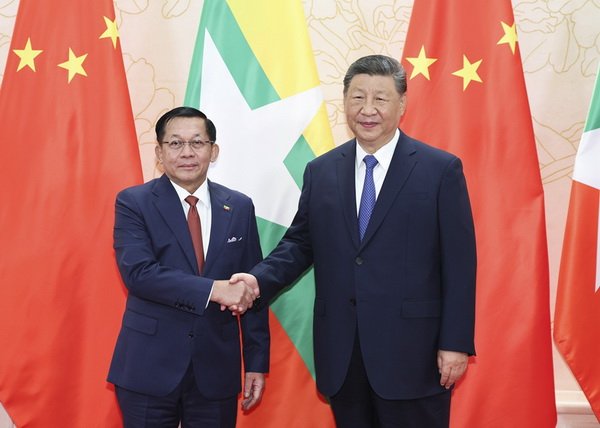
Analysts had previously pointed out that agreements reached during Senior General Min Aung Hlaing’s visit to China before the election—particularly with Chinese President Xi Jinping—were likely aimed at enabling the rapid resumption of these projects.