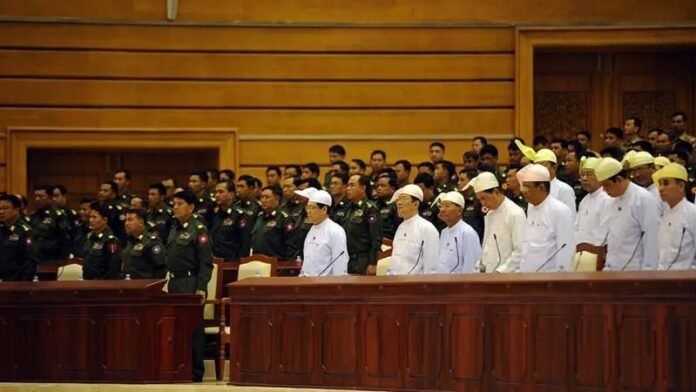
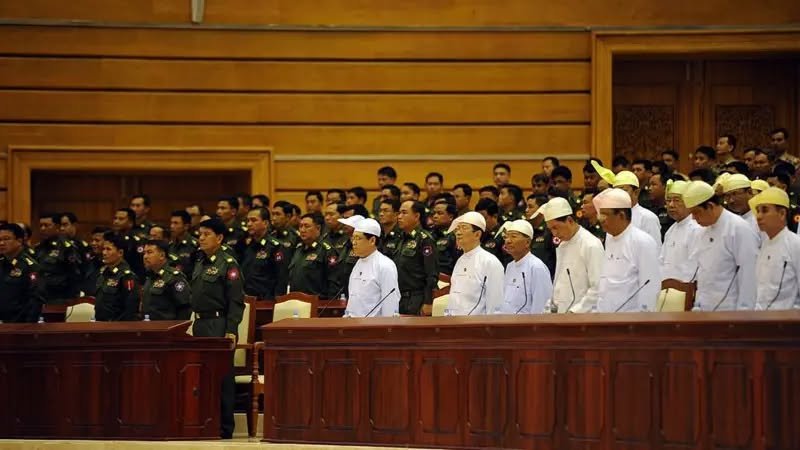
Frequent references in the military leader’s speeches to amending 43 provisions of the Constitution are widely viewed by political parties and ethnic leaders as an effort to further consolidate military rule.
Since the coup, Senior General Min Aung Hlaing has repeatedly stated his intention to amend 43 points in the 2008 Constitution—widely regarded as having been drafted to suit the military’s interests. For years, opposition groups and the public have called for constitutional reform.
Similarly, following a two-day meeting in January 2025 between political parties and the military’s peace negotiation body, the National Solidarity and Peace Negotiation Committee (NSPNC), People’s Party Chair, Ko Ko Gyi also publicly raised the issue of constitutional amendment.
However, no specific details have been disclosed regarding which provisions would be changed.
An ethnic leader involved in the military-led political dialogues told IMNA that the proposed amendments appear aimed primarily at strengthening military control.
“What they call amendments are, in many cases, not real changes but expansions that make the system more entrenched. For example, extending the term of the election commission from five to ten years. These are presented as reforms, but they actually reinforce the existing structure,” the leader said.
Ko Ko Gyi stated to the media after the talks that there had been discussions and some agreement on ensuring the independence of the Union Election Commission and the Constitutional Tribunal.
However, other political parties contacted by IMNA expressed concern that extending the election commission’s term to ten years—as reportedly proposed by the military—would be unfair.
According to Ko Ko Gyi, there was also agreement to amend ten basic principles in Chapter 1 of the Constitution, including formally incorporating a provision to build a “Union based on democracy and federalism.”
Ko Ko Gyi has since been appointed as a member of the advisory council in the military-formed government.
A political analyst questioned the credibility of the military’s promises: “How much can we trust what the military says it will do? And what power do these political parties really have to oppose or restrain the military’s actions? The fact that they cannot clearly disclose the 43 points to the public suggests the military may simply be using them to further entrench its rule.”
One widely discussed proposal involves amending Article 261 to allow regional and state parliaments, rather than the president, to appoint chief ministers directly.
However, U Aung San Myint, Secretary of the Karenni National Progressive Party (KNPP), argued that any federal reforms under the 2008 Constitution would be ineffective.
“Our analysis shows that the 2008 Constitution is fundamentally opposed to a federal system. It offers no real pathway to the kind of a federal democratic union we want. What they call ‘federalism’ is merely a limited delegation of power from the center, while real control remains centralized. Even when chief ministers are appointed, they remain under central control. In practice, the system prioritizes the center over ethnic groups. We cannot accept the 2008 Constitution,” he said.
Unverified reports also suggest that the military leader—who may step down as commander-in-chief to assume the presidency—is considering amendments that would reduce the powers of the military chief while enabling the president to retain power indefinitely.
Political groups argue that as long as the 2008 Constitution remains in place, the military will continue to play a central role in politics. Therefore, any amendments made under its framework are unlikely to be acceptable.