“I started teaching because I was afraid my child wouldn’t be able to speak Mon—and it eventually became a classroom.”
These are the words of Nai Kaw Hnut (also known as Nai Min Tun), who has been independently teaching Mon language and literacy in a Mon village where the language is no longer widely spoken, and where there is little external support.
Nai Min Tun, 39, is from Thakkaw village on Bilu Island (Chaungzon Township), Mon State. With a dark complexion, a sturdy build, and a neat appearance often marked by his glasses, he earns a living as a photographer at donation ceremonies and weddings.
He married a woman from Kywe Chan village in Paung Township and moved there in 2015. The couple has one son.
Kywe Chan village, located near Paung town, is historically a Mon village. However, in recent years, except for some elderly people over 70, most adults, youth, and children no longer speak Mon, making it resemble a Burmese-speaking village.
“My wife doesn’t speak Mon either. When I first moved here, I didn’t even realize it was a Mon village, because only the elderly could speak the language,” he said.
Through conversations with elders, Nai Min Tun learned that the village was established around 60 years ago by Mon people displaced by conflict from Bilu Island, Hpa-An, and Paung.
Over time, as neighboring Burmese and Karen villages grew and more Burmese families settled in Kywe Chan, ethnic mixing increased. As a result, the younger generation gradually lost the ability to speak Mon.
When his son reached school age, he noticed that, like other children in the village, his son could not speak Mon and communicated only in Burmese with friends.
Concerned that his child would lose the language, Nai Min Tun felt a growing responsibility to teach him Mon.
“If we leave things as they are, the children will completely lose the Mon language. So I searched continuously for a teacher in Paung who could come and teach Mon speaking. I went to different Mon departments and organizations, asking them to teach just the spoken language, not even literacy—but I couldn’t find anyone willing to come.”
Unable to find a teacher, he decided to teach the children himself using the Mon language and literacy skills he already had.
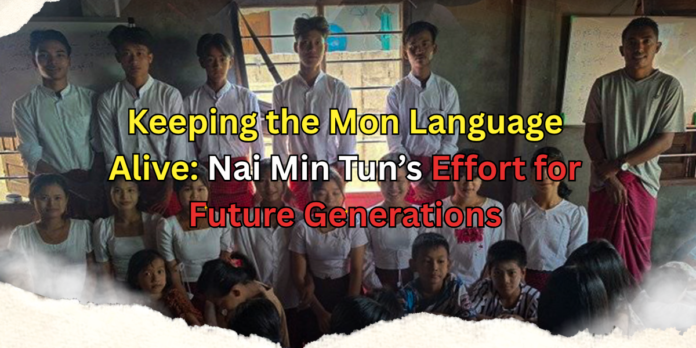
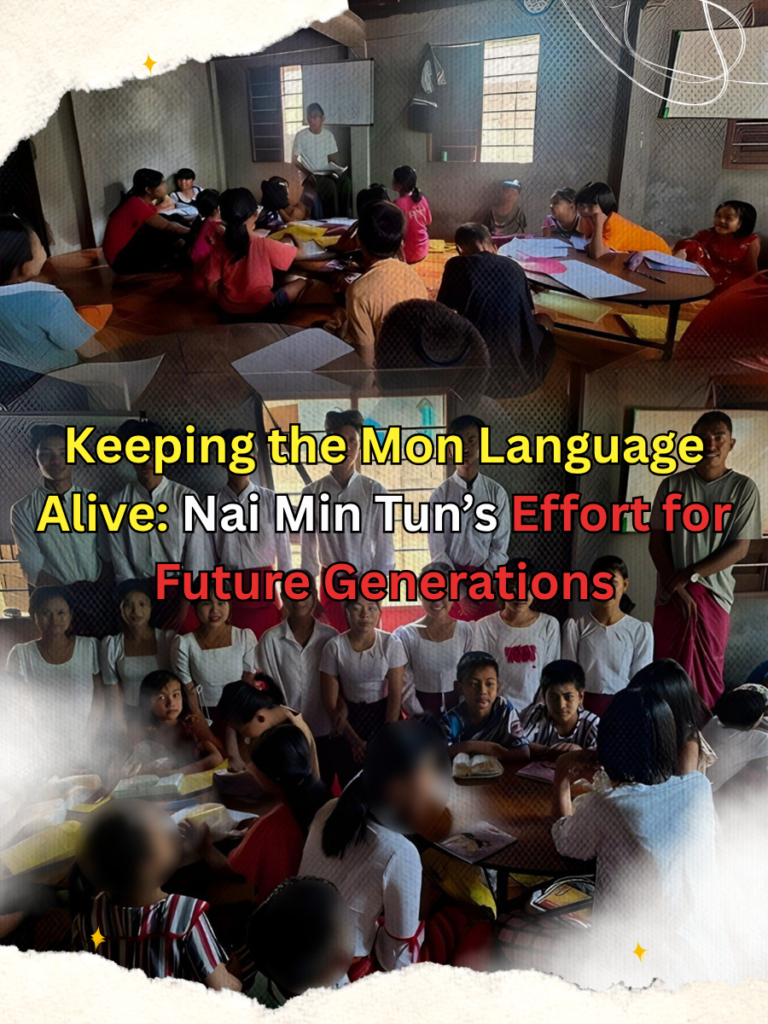
In 2025, he started a small Mon language class at his home, initially with just six children, including his son and his friends.
As he encouraged more families, the class gradually grew to over 40 children.
Teaching children who had no prior understanding of the Mon language has been a major challenge. It has also not been easy to create a fun and engaging learning environment to motivate them.
“The children don’t speak Mon at all, so I don’t start with reading and writing. I focus on speaking first. Since they don’t understand Mon, I teach pronunciation using Burmese sounds and then explain the meanings. I teach for about three hours a day. If they want snacks, I provide them. I also buy drinks for them,” he explained.
During the regular school term, fewer children attend, but during the summer holidays, participation increases significantly.
The class includes children as young as four up to around 15 years old. He also welcomes any youth or adults interested in learning to speak Mon.
As the number of students grows, so does the need for teaching materials.
In 2026, Mon community organizations began supporting the class with books, pencils, pens, snacks, and some financial donations, making the program more vibrant.
Additionally, the Mon Education Department assigned two teachers to assist. Currently, a total of four teachers are involved in running the class.
What began as a personal concern for his son has grown into a source of deep fulfillment for Nai Min Tun, as he now sees children eagerly learning the Mon language.
“Now, when the children go home, they can speak Mon with their grandparents. Many of the elders hadn’t had anyone to speak Mon with for decades. Now they can finally talk with their grandchildren. Seeing and hearing that makes me very happy.”
His efforts are not just for personal or family benefit, but a contribution to preserving the Mon language and literature.
Like Kywe Chan village, even in traditionally Mon communities, the use of the language is declining—especially in villages near towns or those disconnected from Mon cultural networks.
It is time to preserve the Mon language and literature. More individuals like Nai Min Tun, who feel a strong sense of responsibility toward their cultural identity, are needed. Since the Mon language belongs to the entire Mon community, collective effort is essential to ensure its survival for future generations.
Otherwise, the Mon language and literature may remain only in history.