Opinion Analysis, Mehm Sahai
In today’s global geopolitical landscape, the military tensions in the Strait of Hormuz are no longer a distant military or political issue for Myanmar. Instead, they have become a key factor directly affecting daily life and energy security across the region. According to early March 2026 reports, the heat of this conflict has already begun spreading rapidly to the streets of Myanmar.
1. Instability in the Strait of Hormuz and the Lifeline of Global Energy
The Strait of Hormuz is a critical passage through which about 20% of the world’s oil exports flow. Recently, U.S. attacks reportedly destroyed Iranian naval flotillas. At the same time, Iran’s military strategy continues to pose maritime threats through the use of small submarines, sea mines, and coastal artillery positions.
Such insecurity in the waterway could push global crude oil prices as high as USD 150 per barrel. Like Japan, which depends on over 90% of its fuel imports through the Strait, India at around 60%, and China at 45%, Myanmar cannot escape the ripple effects of this maritime risk.
2. Thailand’s Strategic Preparedness
Neighboring Thailand’s response to this global energy shock appears relatively systematic. The Thai Ministry of Commerce is reportedly preparing to address rising fuel prices and transportation costs through a six-point action plan.
Their policy focuses on preventing price speculation, relocating supply sources to safer channels, and supporting exporters. This represents a model of responding to global crises through organized preparation.
3. Myanmar’s Practical Crisis and the “Odd–Even” System
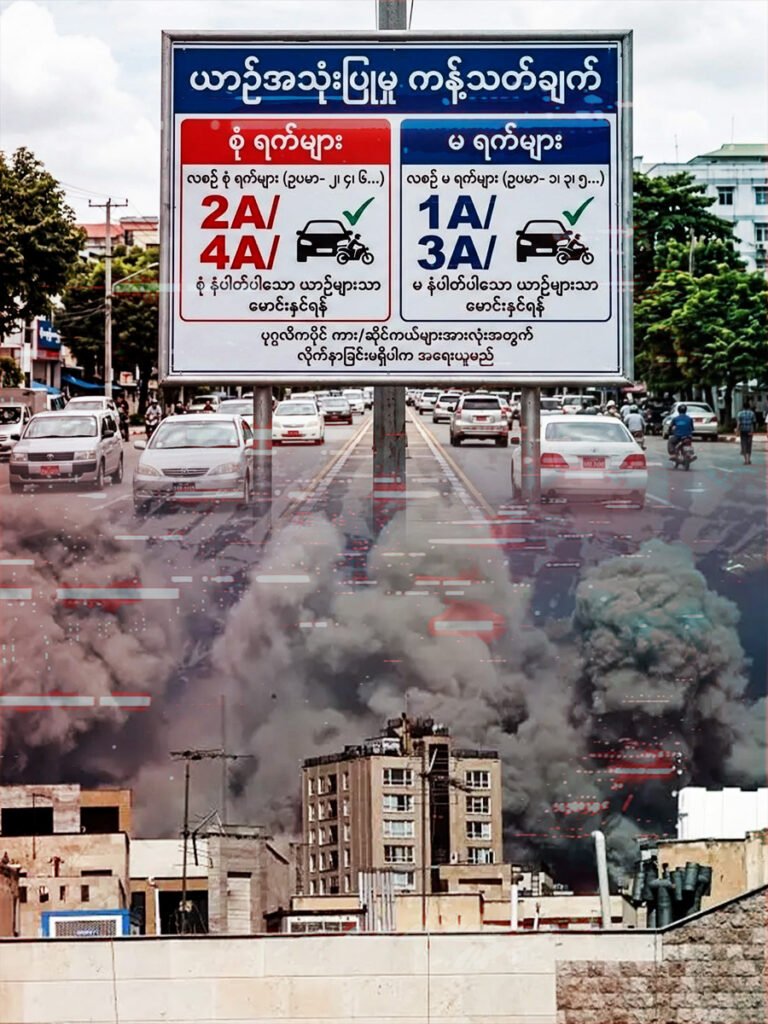
Myanmar’s response stands in stark contrast. The country relies heavily on imported fuel, and its strategic fuel reserve is extremely limited. Business sources say Myanmar purchases crude oil from Iran, refines it in Singapore, and then re-imports the processed fuel. The current war has therefore effectively “choked” Myanmar’s energy supply chain.
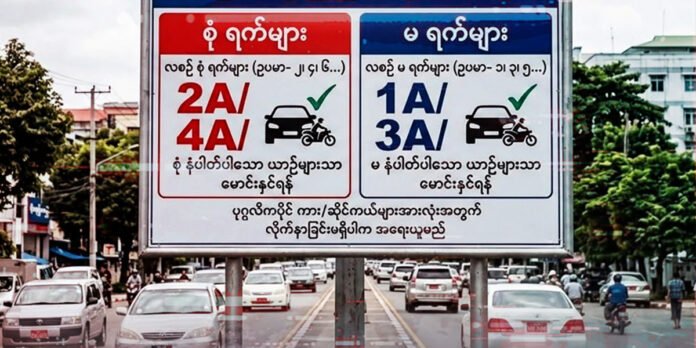
To address the situation, the authorities announced a vehicle restriction policy starting March 7, requiring private vehicles to follow an “odd–even” license plate system. This approach resembles the resource rationing policies practiced during the 1980s Myanmar Socialist era.
4. Logical Consequences of the Policy
Although the odd–even system is applied only to vehicle movement, several indirect impacts are expected:
(a) Transportation and Commodity Prices
Restricting private vehicles will increase demand for public transport and taxis, driving up travel costs. Fuel shortages will also push transportation costs higher, ultimately leading to significant increases in basic commodity prices.
(b) EV Policy and Ground Reality
Allowing electric vehicles (EVs) to operate daily may serve as a symbolic relief measure. However, with electricity generation already insufficient and fuel use restricted even for running generators, EV users may also face difficulties.
(c) Black Market Expansion
When legal fuel sales are restricted, the black market is likely to grow significantly, further worsening inflation.
5. Conclusion and Future Outlook
In summary, the conflict in the Strait of Hormuz may represent systematic preparedness for neighboring countries, but for Myanmar’s public, it has already translated into street-level restrictions and a regression toward past-era resource controls.
As long as global energy markets remain unstable and domestic fuel reserve management remains weak, the people of Myanmar will continue to bear the bitter consequences of the fuel crisis.