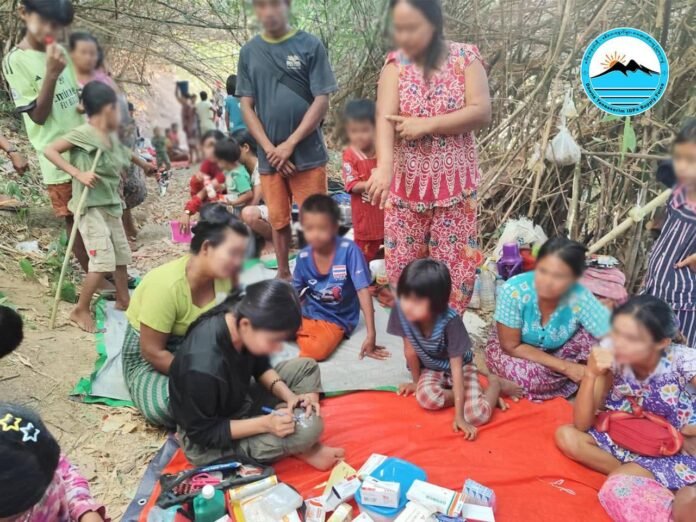
Fighting in Tanintharyi Region, including in Dawei District’s Launglon and Thayetchaung townships, as well as military operations around Mawdaung, has displaced more than 83,700 people, according to local aid groups.
As the number of internally displaced persons (IDPs) continues to rise after five years of conflict, humanitarian organizations say dwindling public donations and reduced international assistance have made it increasingly difficult to meet growing needs. Aid workers estimate that nearly two-thirds of displaced people are currently receiving little or no assistance.
To learn more about the challenges facing IDPs and the efforts being made to coordinate humanitarian responses, IMNA interviewed Ko Zaw Naing, leader of the Dawna Tenasserim IDPs Supply Force.
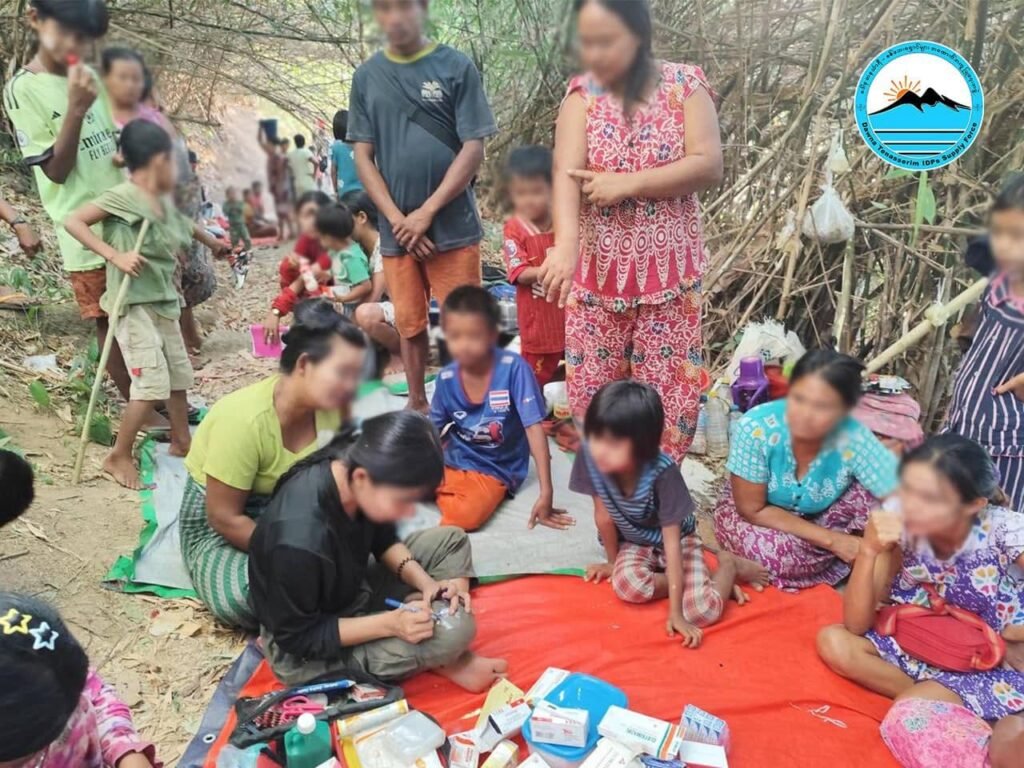
Question: What difficulties are IDPs currently facing on the ground in Tanintharyi due to military operations and ongoing fighting?
Answer: Fighting has continued over the past one or two months. Clashes have taken place across Dawei District and in other townships throughout the region. It is difficult to provide an exact number of displaced people.
At present, fighting is ongoing in Launglon and Thayetchaung townships in Dawei District, where military offensives have forced civilians to flee. In southern areas such as Mawdaung and other parts of Tanintharyi, there are also large numbers of displaced people.
The rainy season has made the situation even more difficult. IDPs are facing shortages of rain protection and increasing health concerns. Tanintharyi receives heavier rainfall than many other areas, making it difficult for people to shelter in forests and mountainous areas. Many have sought refuge in nearby communities, monasteries, and schools.
Question: Why has humanitarian assistance become weaker, and what makes aid delivery increasingly difficult?
Answer: Over the past five years, the number of displaced people has steadily increased. In the early stages of the conflict, the number of IDPs and the scale of fighting were smaller, so available resources and budgets were sufficient to provide assistance.
However, as displacement has grown, it has become increasingly difficult to support everyone. Some areas remain inaccessible. For example, if there are 500 displaced people in one location, we may only have enough resources to assist around 200, leaving the remaining 300 without support.
Aid groups have had to coordinate and work together to address these challenges. At the same time, public support has gradually declined. Many people are struggling with their own livelihoods, while others are focusing on education and healthcare needs. As the revolution continues over a longer period, the capacity to support IDPs has weakened.
International assistance has also declined. Even when aid is requested, it often arrives too late. In some cases, assistance reaches communities only after displaced people have already returned home.
Question: How are aid organizations overcoming these challenges and responding to the needs on the ground?
Answer: Since the beginning of the conflict, international assistance to Tanintharyi has been limited for various reasons. This is not a challenge unique to Tanintharyi; it is a nationwide issue.
Organizations working with displaced communities in the region are trying to strengthen coordination through CSOs Nexus Consortium networks so that aid groups can speak with a unified voice and provide more effective support. At the same time, we are cooperating with local armed groups and administrative bodies to resolve some of the challenges faced on the ground.
Question: Which areas are the most difficult to reach with humanitarian assistance?
Answer: During the rainy season, when battles such as camp seizure operations occur, displaced people often flee to villages located farther away from conflict zones. During the dry season, many can shelter in nearby forests and mountains, but in the rainy season that becomes much more difficult.
There are also times when routes to displacement sites are blocked because of ongoing fighting. Areas where military columns are operating cannot be accessed easily. In some unstable areas, local People’s Defense Forces also restrict movement for security reasons.
Heavy rains create transportation problems as rivers overflow and roads become damaged, making travel difficult. Internet disruptions also make it challenging to communicate with displaced communities and assess their needs.
Question: What would you like to say about the long-term needs and challenges facing displaced communities?
Answer: Whenever people are forced to flee, the immediate priorities are food, medicine, and emergency supplies.
Health challenges vary depending on the season and local disease outbreaks. One of the most serious issues across the region is malaria. In some villages where malaria was previously uncommon, the disease has spread through population movements as displaced people arrived from affected areas. Increased movement between communities has also contributed to transmission.
Addressing these outbreaks requires sufficient medical supplies, but there are not enough medicines available. More assistance is urgently needed. It is also very difficult to maintain regular support for displaced communities.
As part of preparedness efforts, communities in villages that frequently receive displaced people can coordinate to store food supplies in advance. However, emergency needs continue to arise, and resources remain limited. Long-term stockpiling is difficult, and aid organizations themselves face many operational challenges.