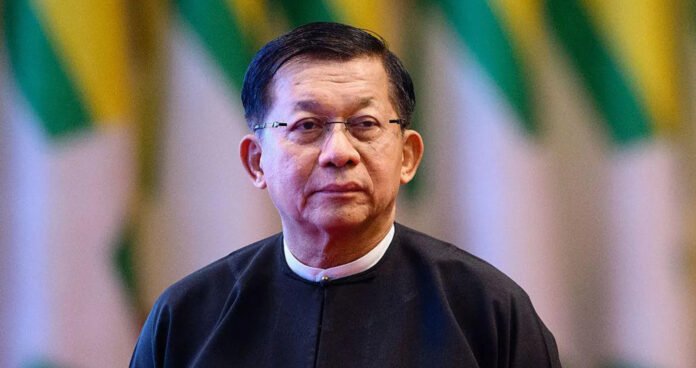
Amid deepening military, political, and economic crises, coup leader Min Aung Hlaing has forcibly assumed the presidency. Claiming to establish a civilian government, the military held what critics describe as a sham election and, based on those results, Min Aung Hlaing took office as president and formed a government.
It remains a serious question whether the military leader, now serving as president, can or will resolve the international legitimacy issues, economic decline, and armed conflicts that have worsened since the coup.
According to Chin Human Rights Organization (CHRO) spokesperson Salai Mang Hre Lian, it will be difficult for Min Aung Hlaing to gain international legitimacy, as he faces legal cases in international courts, including allegations related to genocide.
“Min Aung Hlaing assuming the presidency is not a genuine political transition for Myanmar. It is merely the same leader—responsible for past coups and atrocities—changing titles to legitimize military dictatorship. Simply renaming a coup leader as ‘president’ cannot bring legitimacy or stability. The international community must be cautious not to treat this staged transformation, built on violence, as normal while ignoring the people’s democratic aspirations and international crimes,” he said.
Over the five years since the coup attempt, nearly 8,000 people have been killed and more than 10,000 imprisoned.
From a military perspective, the armed forces have been losing territorial control in some regions and states. Armed resistance has intensified compared to the pre-coup period, with ongoing clashes, base seizures, and airstrikes continuing even during parliamentary sessions.
Military analysts say that the expanding conflict sparked by the coup is unlikely to be contained by Min Aung Hlaing, despite his assumption of the presidency, and violence is expected to continue.
CDM Captain Zin Yaw, a military analyst, said “There could be temporary ceasefires with some ethnic groups. But in regions like Sagaing, Magway, Bago, and Ayeyarwady, we are likely to see more brutal airstrikes and military offensives.”
He also noted that in major cities already under military control, authorities are reintegrating military officers into administrative sectors and preparing to revive an intelligence system reminiscent of the past.
The military is also organizing peace processes alongside forming a government, leading to speculation that future peace talks may occur.
However, the analyst added “Their peace talks may only involve around seven EAOs. Broader ceasefires, such as with the Kachin, are unlikely. If real peace negotiations begin, the military would have to make concessions—which it does not want. So fighting will continue as long as possible; only when it can no longer sustain it, might it concede. For now, conflict will persist.”
There are also expectations that the military will continue airstrikes and ground offensives in an attempt to regain lost territories.
Meanwhile, the country continues to face economic challenges, including declining foreign investment, currency depreciation, rising commodity prices, and shrinking job opportunities.
Since the coup, foreign companies—including telecommunications operators—have steadily withdrawn, while the Myanmar kyat has depreciated from around 1,000 per U.S. dollar to nearly 5,000.
Policy missteps—such as arresting gold shop owners when gold prices rise or detaining fuel sellers when fuel prices increase—combined with international sanctions, are seen as major obstacles to economic recovery under the military regime.
Whether the military leader—now president—can build public trust, reduce armed conflict, and stabilize the economy remains a central and unresolved question for Myanmar’s future.