By Ar Ba Lai
There is a region where, every year, starting from early April as Thingyan approaches and continuing until the 10th day of the New Year period after Thingyan, a traditional pagoda festival is held in rotation—one or two villages taking turns each day.
That region is Chaungzon Township, also known as Bilu Kyun (Ogre Island), located across the river from Mawlamyine. Surrounded by water and home to a majority Mon population, it is a culturally rich area.
Bilu Kyun consists of 47 village tracts and 78 villages. Its pagoda festival tradition is truly unique—unlike anything found elsewhere. It can be described as a “rotating village pagoda festival” or even a grand communal donation festival.
This tradition dates back over a hundred years and has been carefully preserved and passed down through generations by the people of Bilu Kyun.
An 80-year-old resident, Nai Aung from Kamar Mo village, shared what he learned from elders:
“I’ve been participating in this festival since I was 15. It’s been going on for hundreds of years. In the past, travel between villages was very difficult due to political conditions. So this system made it easier for people to visit one another.”
Another reason behind the festival lies in the region’s agricultural lifestyle. Since Bilu Kyun is primarily a farming area, the festival is held after the harvest season and before the rainy season begins. It serves as a time for friends and communities to reunite, discuss farming matters, exchange ideas, and strengthen relationships.
During the festival, every household in the host village prepares a wide variety of food to welcome guests. Visitors—whether acquaintances or strangers—from near and far are warmly received and generously treated.
Interestingly, households that receive many guests feel proud and joyful, while those with fewer visitors may feel a bit disappointed. It is a charming and heartfelt Mon tradition.
Guests are also expected to at least taste the food offered—snacks, drinks, meals, and even traditional beverages—as a gesture of appreciation, which brings satisfaction to the hosts.
In addition, hosts often introduce visiting young guests to their own children, fostering friendships that sometimes even lead to romantic relationships.
“In the past, guests would arrive three days before the festival. Hosts were incredibly happy to receive visitors because it meant forming new friendships with people from other regions. Those connections often became as close as family,” Nai Aung said with a smile.
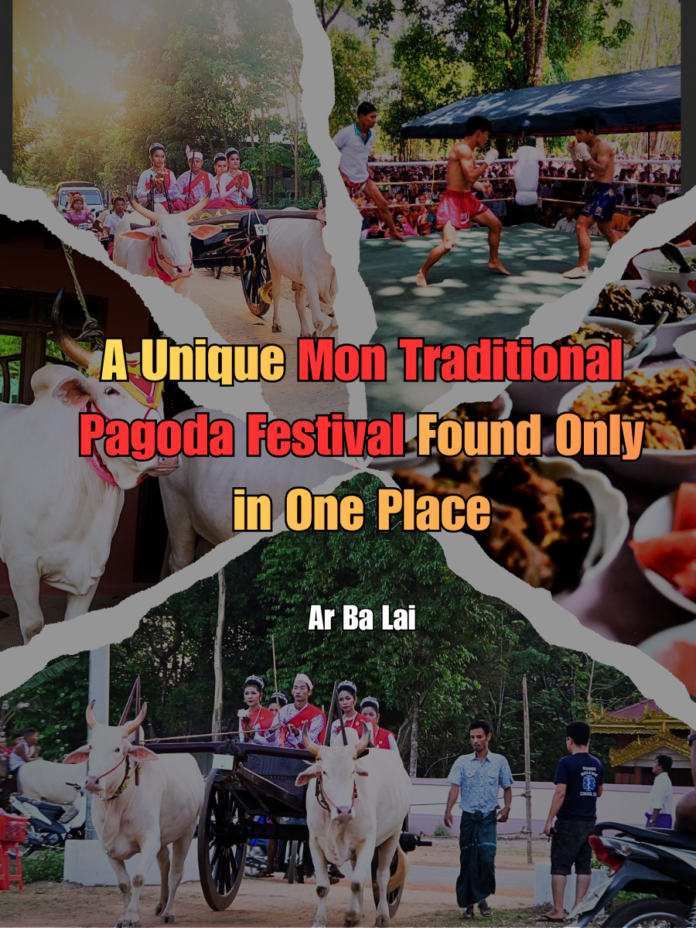
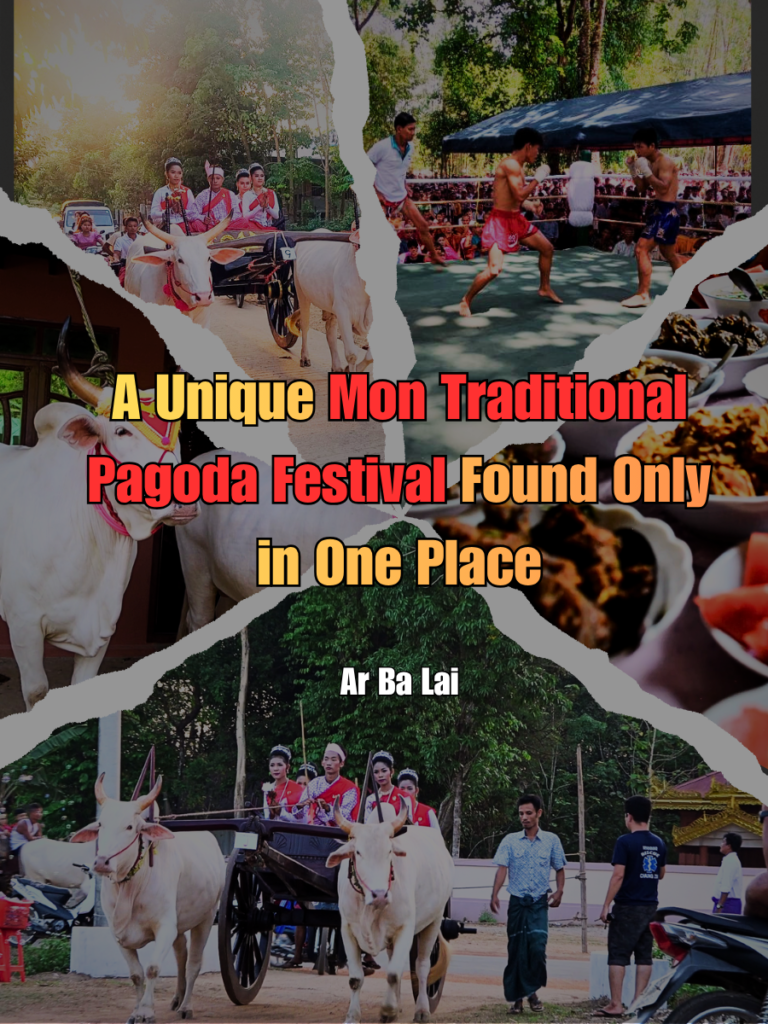
On the festival day, visitors go from house to house enjoying food. Around midday, they gather at pagoda compounds or monasteries to watch traditional boxing matches. In the evening, they climb the pagoda for worship.
One distinctive feature of Kamar Mo village’s festival is the traditional Mon ox-cart decoration competition.
In earlier times, almost every household owned an ox cart and used it to transport guests to the pagoda. This led to the creation of the ox-cart decoration contest.
Each cart is assigned a number, and three or four young men and women dressed in traditional Mon attire sit gracefully on the cart with hands clasped, as it is paraded around the village.
Judges evaluate both the cart’s decoration and the participants’ attire, selecting the most beautiful and rule-compliant entry.
“In the past, people went to the pagoda by ox cart. In the evening, more than 500 carts would head toward the pagoda. Guests were taken there by their hosts’ carts. That’s how the competition began—judging which cart was the most beautiful. The young people on the carts would laugh, cheer, and joke—it was incredibly fun,” Nai Aung recalled.
However, after the opening of the Bilu Kyun Bridge in 2017, which connects Mawlamyine to Bilu Kyun, the tradition of traveling to the pagoda by ox cart has gradually declined.
On the other hand, improved transportation has made the festival more accessible, attracting more visitors.
Yet, as most visitors now come only for the day instead of staying overnight, the tradition of forming deep connections and friendships is slowly fading.
“Since visitors return the same day, there’s less opportunity to build relationships. People come mainly for enjoyment now. Younger generations even request motorcycle competitions instead of ox-cart traditions. We want to preserve these customs, but we also know they may disappear in the future,” Nai Aung said with a sense of sadness.
Despite these challenges, the author expresses deep admiration for the people of Bilu Kyun, who have preserved this cultural tradition for generations.
Visitors from near and far are encouraged to experience this one-of-a-kind festival—found only in this part of Myanmar—and younger generations are urged to continue safeguarding this valuable cultural heritage.