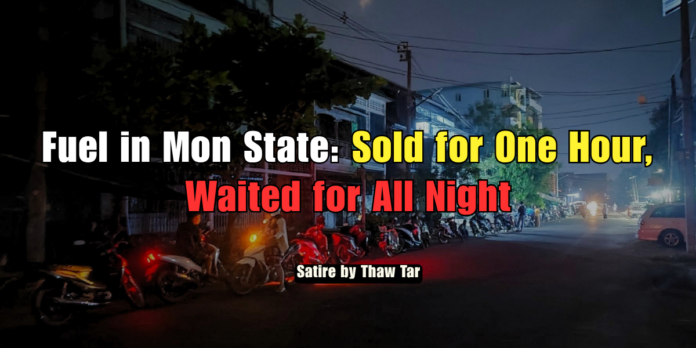
Satire by Thaw Tar
The military council’s Ministry of Energy has been continuously issuing rules and regulations to ensure that fuel buyers are not disadvantaged. The announcements come as fast as lightning—but actually getting fuel feels as unlikely as rain falling on demand.
Today it’s one system, tomorrow another, the day after yet another. But the crowds lining up at fuel stations only grow longer with each new system, stretching endlessly without a break.
People now spend their days listening closely for news of when a nearby fuel station might start selling. If you miss the announcement, you’re simply out of luck.
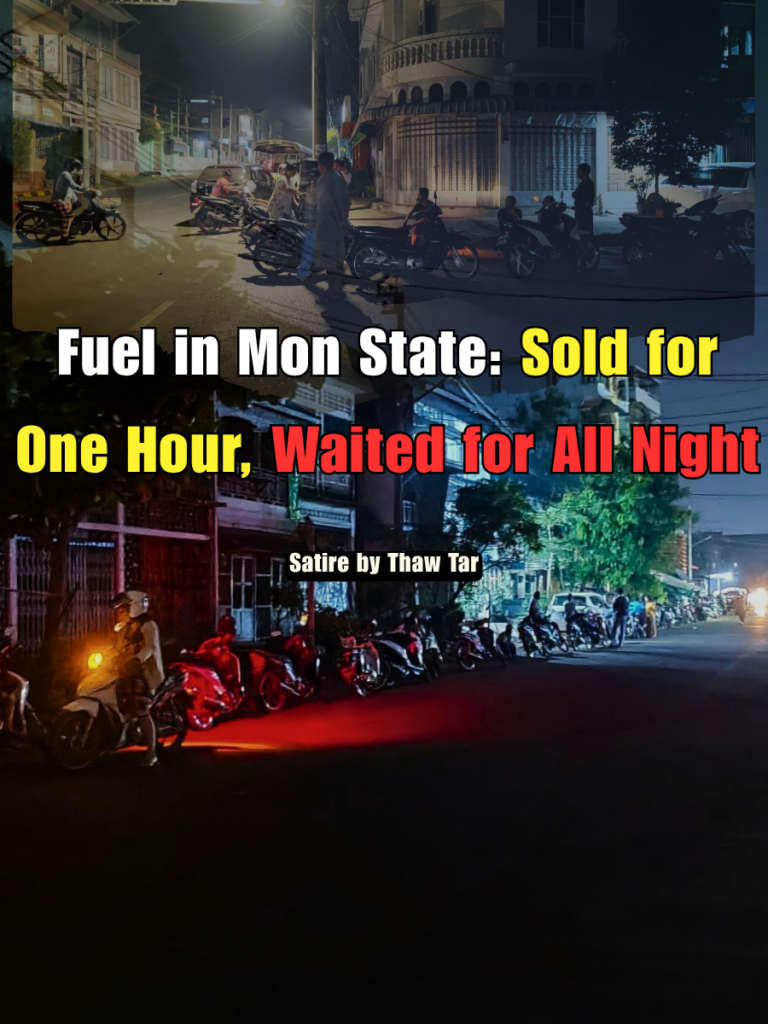
Sometimes stations announce in advance, “Fuel will be sold at 9 a.m.” Other times, they open and close without warning, sending cars and motorbikes rushing frantically to line up.
Although fuel is sold for only about an hour each day, customers effectively receive a “free service” of waiting in line all night.
It’s no longer surprising that fuel stations fail to follow the military council’s regulations. After all, the rules seem to exist only on paper, while stations operate however they please.
Even ambulances are not exempt from the odd-even license plate system. A patient may need to survive, but the vehicle must first have the “correct” number. It’s a country where an odd or even number can outweigh human life.
Earlier, it was said that each motorbike could purchase up to 10,000 kyats worth of fuel. In reality, however, it’s more like 5,000 kyats every two days—or sometimes just 3,000. Instead of buying fuel, people feel like they’re buying hope.
Now, a new system has been introduced—fuel sales based on travel distance. Though intended to curb misconduct, in practice, it seems like yet another layer added just to control more misconduct.
No matter how many new rules are introduced, one sign appears consistently at every station: “No fuel available.” Perhaps this is the most unified system in the country. Fuel may be inconsistent, but the message “Not available” is perfectly consistent.
Today’s fuel crisis is no longer just about fuel—it has become a daily endurance test of people’s lives.