Due to the ongoing military conflicts in the Middle East, a global oil and fuel crisis has emerged. While the fuel crisis may appear to be merely a supply shortage, its consequences are spreading across multiple sectors like a widespread disaster.
In Myanmar, people are also experiencing the effects of the fuel crisis, including rising fuel prices, restricted purchasing, and long hours spent queuing to buy fuel. Although the military junta has introduced policies to conserve fuel and ensure sufficiency, these measures have proven ineffective, worsening the public’s hardships.
Military Fuel Restrictions
Authorities have imposed an odd/even system for vehicle refueling. Daily fuel limits are set as follows: motorcycles 5,000 kyats, tuk-tuks 10,000 kyats, private cars 30,000 kyats, passenger buses 100,000 kyats, and premium diesel 30,000–40,000 kyats. Sales are restricted from 6:00 AM to 6:00 PM, with barcode/QR code systems limiting purchases.
Additionally, fuel stations are prohibited from selling fuel in containers and from increasing prices beyond official rates. A barcode system for cars and a QR code system for motorcycles have also been introduced, limiting purchases to once or twice per vehicle.
Challenges in Accessing Fuel
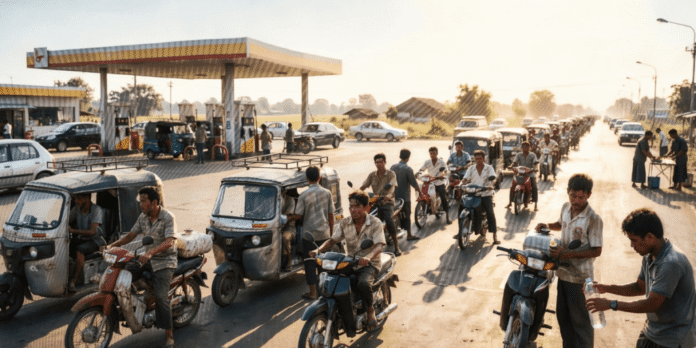
Since early March, fears of fuel shortages driven by the global crisis have caused panic buying. As a result, long queues have formed at fuel stations, with people crowding and waiting for hours to purchase fuel.
Even after nearly a month, long lines persist, and the situation is worsening day by day. People often wait for hours under the hot sun just to buy fuel.
Queue times can range from 1 hour to half a day. Even then, a motorcycle typically receives only slightly over one liter of fuel for 5,000 kyats. This amount is often insufficient even for daily transportation needs, forcing some individuals to queue multiple times a day just to secure enough fuel.
Lines of vehicles stretch for miles, and some people even stay overnight in queues.
Despite implementing the odd/even system, the junta has failed to reduce congestion; in fact, queues have grown even longer.
Because of restrictions and limited availability at fuel stations, many people—especially those who cannot legally purchase fuel, such as unlicensed vehicle owners—have turned to the black market.
Expansion of the Black Market
Whenever fuel shortages occur, a black market tends to emerge. Currently, as fuel becomes increasingly scarce and difficult to obtain, the black market is expanding rapidly.
Those who can afford it and do not have time to queue rely on black market fuel. While official stations impose limits, the black market allows buyers to purchase as much as they want, contributing to its growth.
Some fuel stations are reportedly also diverting supplies to the black market to earn higher profits. This reduces the supply available at official stations and worsens shortages for ordinary customers.
The military’s handling of the fuel crisis—through restrictive policies and ineffective enforcement—has further complicated the situation for the public.
Although authorities have banned the sale of fuel in containers, many stations reportedly continue illegal sales without facing enforcement action, contributing to the worsening crisis.
Currently, official fuel prices range between 3,300 and 3,500 kyats per liter, while diesel costs between 4,000 and 4,300 kyats per liter. On the black market, however, prices range from 15,000 to nearly 20,000 kyats per liter.
Impact on Daily Life
The fuel crisis has gone beyond a simple energy issue and has become a major hardship affecting both the livelihoods and mental well-being of the public.
Spending hours in queues results in lost working time and rest. Limited fuel availability creates significant challenges for long-distance travelers and taxi drivers.
Rising fuel prices have also led to increases in transportation costs and freight charges. As transportation costs rise, so do the prices of goods. The increase in basic food prices has created food insecurity, especially for low-income families.
Fuel shortages are also disrupting sectors that depend on fuel, such as agriculture, fisheries, and small businesses, forcing some to halt operations entirely.
“The biggest challenge is for farmers. Cutting grass, clearing land, and irrigating fields all rely on machinery, so fuel is essential. Fuel isn’t sold in containers, so we have to queue with motorcycles or cars, extract the fuel, and use it. Without container sales, it’s very difficult to continue our work.”
Conclusion
The current fuel crisis has been exacerbated by flawed policies from the military authorities. Effective solutions are urgently needed. Without timely intervention, the daily lives of the public may deteriorate further into deeper hardship.