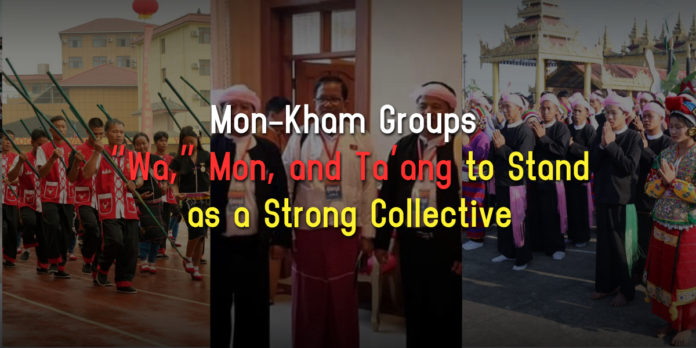
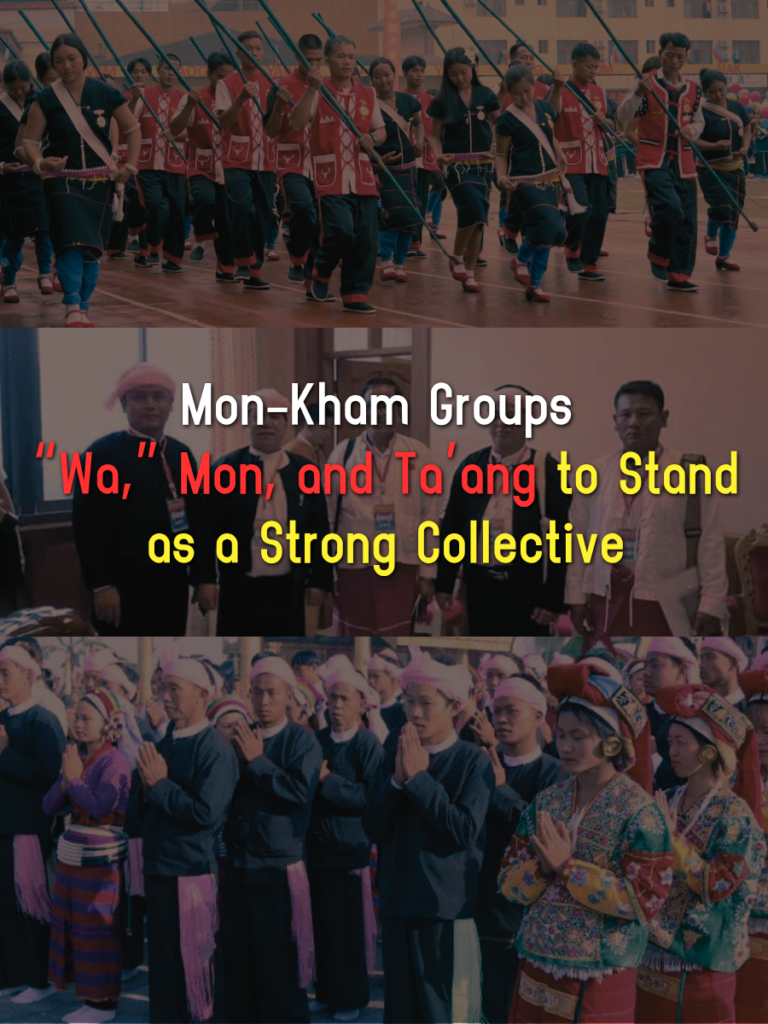
A spokesperson for the “Wa” youth voice told IMNA, that members of the Mon-Khmer “Wa” group, along with the Mon and Ta’ang (Palaung) communities, have formed a strong alliance.
The spokesperson explained that their youth group was initially organized after the military takeover, and during the 1027 military campaign, youth from the “Wa,” Mon, and Ta’ang communities strengthened their connections.
“We formed these three groups to build a strong and unified force. We need a lot of youth power to move forward together. Beyond politics and military matters, our Mon-Khmer alliance also aims to preserve our culture, history, traditions, and heritage while progressing as a strong group,” the spokesperson said.
After the military takeover, the Wa Youth Voice, Ta’ang student and youth groups, and the Progressive Mon Youth Organization publicly stated that they would unite the Mon-Khmer groups to resist any actions by the military that would extend its power.
Historically, the Mon and Ta’ang (Palaung) communities have cooperated in certain areas, and since the military takeover, they have coordinated in military and political matters. However, connections between the Mon and the “Wa” group had been relatively weak.
Dr. Pon Nya Mon, head of Mon National College, told IMNA that cooperation between the Mon and Ta’ang communities has strengthened in the cultural and educational fields.
In education, the Mon community has taken a leading role, while the Ta’ang (Palaung) communities have sought to improve their own education, leading to joint efforts and exchanges.
Dr. Pon Nya Mon said, “Our ties with Palaung are not only political; they include cultural collaboration and youth engagement. These connections existed before, and later, during the Spring Revolution, military coordination emerged. Today, collaboration with Palaung continues to strengthen.”
Although the “Wa” belong to the Mon-Khmer ethnic group, their close ties with China have limited their connections with other groups, and they are unsure whether other Mon organizations are connected to them.
Currently, networks exist between Mon educational organizations and the Ta’ang (Palaung) educational institutions, and they are cooperating.
Regarding military coordination between the Mon and Ta’ang (Palaung), the specifics are unclear, but the Ta’ang Women’s Organization (TWO) noted that political collaboration shows promising prospects.
“From a political perspective, this is encouraging. On the Mon side, we track current political and ground realities. On the Ta’ang side, we exchange information on political and local conditions. Such coordination supports the success of the revolution and the activities of revolutionary groups,” they said.
Among Myanmar’s ethnic armed groups, the United Wa State Army (UWSA), the most powerful, is known to provide arms support to other groups, including the TNLA.
Additionally, some Mon revolutionary armed groups have received basic military training and other assistance from the Ta’ang National Liberation Army (TNLA) in Shan State.
A spokesperson for the Wa Youth Voice said, “The main goal is to unite Mon-Khmer youths from the ‘Wa,’ Mon, and Ta’ang communities. We want to come together as a single force, so that no one struggles alone.”
The Mon-Khmer “Wa,” Mon, and Ta’ang (Palaung) communities have strengthened youth coordination during the Spring Revolution and have also enhanced cooperation in other political and military spheres compared to before.
Historical migration records indicate that tens of thousands of Mon-Khmer people—including Mon, Wa, and Ta’ang (Palaung) communities—migrated from southern Yunnan, China, through the Shweli, Taping, Nam Hkawn, and Mekong river basins, and have settled in these regions, according to the TNLA’s press department.