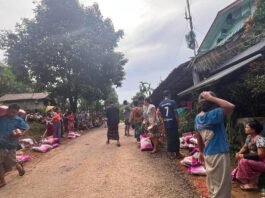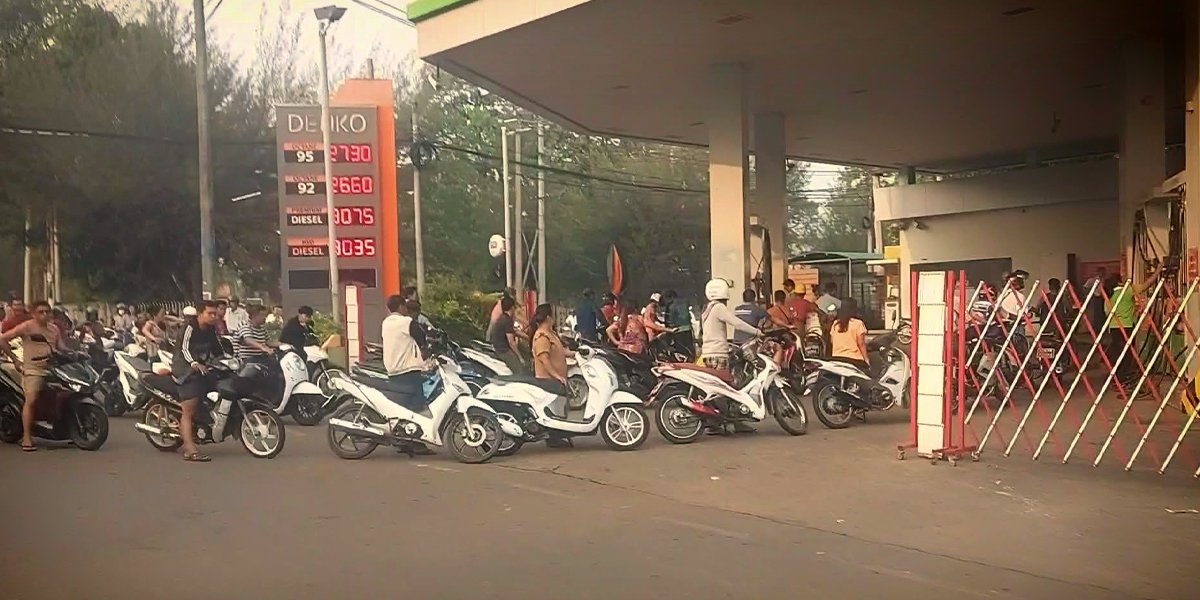
Although the military council has instructed fuel business owners in Mon State to sell fuel according to fixed quotas, some stations have had to temporarily stop sales and close because demand surges while supply remains limited.
The Petroleum Products Regulatory Department has instructed fuel stations in Mon State to sell fuel with the following limits: 5,000 kyats for motorcycles, 10,000 kyats for three-wheeled vehicles or tuk-tuks, 40,000 kyats for private cars, and 100,000 kyats for passenger buses and cargo trucks. Although there is reportedly enough fuel to last about a month, panic buying creates a trader-driven market and pushes prices higher.
To understand the current fuel situation in Mon State, the Independent Mon News Agency interviewed a fuel business owner in Mawlamyine.
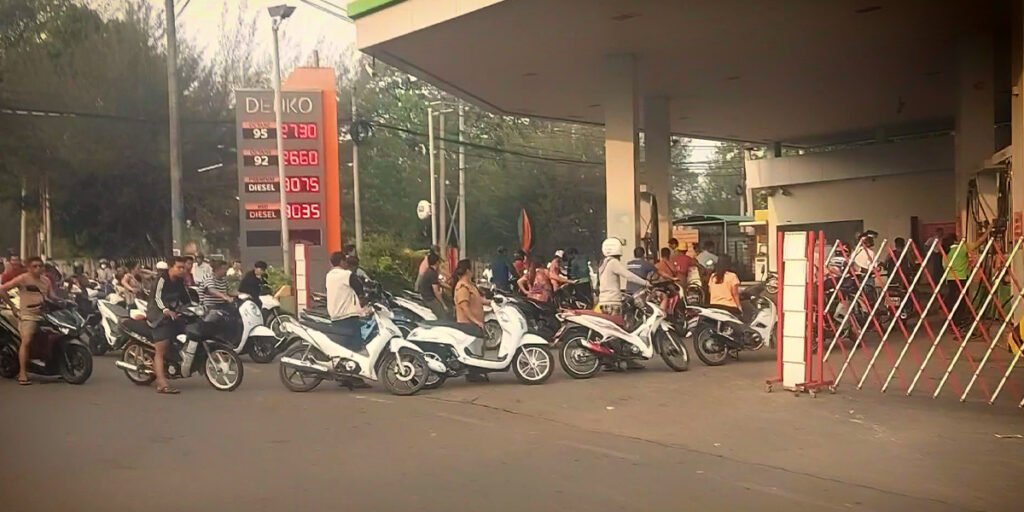
Question: How are fuel stations in your town currently selling fuel to customers?
Answer: We sell strictly according to the quota. We can’t buy from other stations to restock, and if we run out, we have to close. For example, a fuel tanker arrived at our station yesterday, but many people came with containers to buy in bulk. The fuel almost ran out, and the next shipment will only arrive in seven days, so supply becomes insufficient. We sell for a short time, then close to reserve some fuel for the next day. Currently, quotas are 5,000 kyats for motorcycles, 10,000 kyats for three-wheelers or tuk-tuks, 30,000 kyats for private cars, and 100,000 kyats for passenger vehicles’ diesel. Premium diesel is 40,000 kyats for red-plate vehicles and 30,000 kyats for black-plate vehicles. These limits make it difficult for farmers.
Question: Could you explain the supply chain for fuel in Mon State?
Answer: We buy fuel from importers bringing it from abroad. In Mon State, we purchase from MEK Importer in Mudon. Previously, fuel came through Yangon’s Thilawa Port, but now most fuel enters through Mudon Port. Fuel is distributed once a week, and we can only receive the assigned quota. Once our quota is used, we must stop selling until the next supply.
Question: Given the current global situation, could fuel imported through these routes run out?
Answer: Since fuel comes from abroad, shipments aren’t easy to get. For now, there are still reserves. Officials told fuel business owners that shortages could occur and provided documents specifying quotas for vehicles and motorcycles.
Question: How long do you think Mon State’s fuel supply can last?
Answer: Compared to Yangon or Mandalay, Mon State currently has the largest remaining supply. There should be enough for about one month if conditions remain stable. Two or three tankers are still waiting to unload. If people buy only what they need, supply will last longer. But if panic buying continues, shortages could happen. Authorities also don’t want stockpiling and have issued laws to control it. Under normal circumstances, however, it shouldn’t reach that point yet.
Question: Do you think the junta’s current regulations encouraging reduced fuel use will be effective?
Answer: It’s hard to say. People still need to go to work, so the system might not be sustainable. Without real enforcement, the rules remain on paper. Controlling fuel sales by limiting the days it can be sold might be more practical.
Question: What precautions are you taking since authorities will act against businesses that stockpile fuel or raise prices?
Answer: We cannot sell fuel in containers or barrels, and prices cannot be raised. Inspections are frequent, so we only sell at the government-set price. The quota system mainly controls foreign currency use. Previously, traders could buy and sell freely. This system has been in place for about three years, which makes regulation easier. Large companies get bigger quotas, smaller stations smaller quotas. For example, if our weekly quota is 7,000 units, and we sell 1,000 in one day, we must stop sales until the next day until the quota is used up.
Question: Any other comments on the current fuel situation?
Answer: The main problem is panic buying. When people rush to stockpile fuel, it benefits traders and can create a black market. If people only buy what they need daily, supply is sufficient. But if panic spreads, the market becomes unstable. Some people who can afford it pay more to skip lines, and traders raise prices even though they shouldn’t.