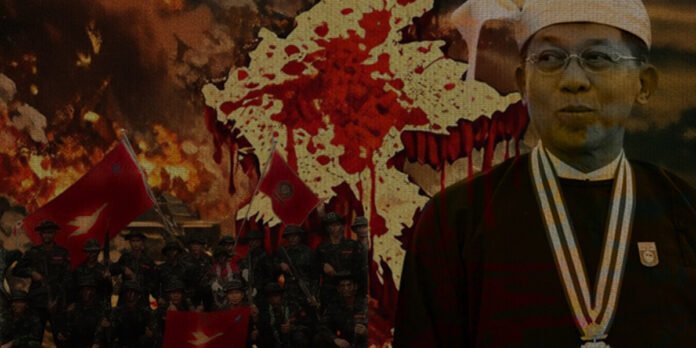
Following the 2026 election organized by the military commission, Mon State has not moved toward peace but has instead descended deeper into intense armed conflict and widespread human rights violations. In northern townships such as Thaton, Bilin, and Kyaikto, as well as southern townships including Ye and Thanbyuzayat, junta forces have reinforced their presence with large troop deployments. As a result of these offensives, fierce clashes have erupted with joint revolutionary forces.
The military council is attempting to use the election it conducted as justification to forcibly activate and expand its administrative machinery. However, on the ground, in areas where it lacks effective control, it has resorted to indiscriminate artillery shelling and the burning of villages in an effort to intimidate civilians and entrench its authority. Due to the military’s inhumane actions, local residents are facing an increasingly alarming situation.
Continuous airstrikes, drone attacks, and heavy artillery fire into civilian-populated villages have resulted in casualties and injuries among innocent civilians.
Arbitrary arrests, forced portering, and the use of civilians as human shields are reportedly occurring on a daily basis. Homes have been broken into, with money, phones, and motorcycles confiscated, and some houses set ablaze. As a consequence of the military’s actions, hundreds of thousands of people have been forced to flee their homes in search of safety.
Amid this military and human rights crisis, the stance of Mon political forces has become a matter of serious concern. Political parties attempting to survive within the restrictive framework imposed by the junta through the electoral path have remained largely silent regarding the repression suffered by civilians. Such silence, it is argued, risks reducing them to mere instruments of the military council.
For the New Mon State Party (NMSP), which continues to adhere to the Nationwide Ceasefire Agreement (NCA) path, the challenges are immense. The dialogue-based approach has proven unable to prevent the junta’s offensives or the use of civilians as human shields. As such, a reassessment of its position appears increasingly necessary.
The fighting taking place in Mon State is not a simple territorial dispute, but a decisive struggle between “authoritarianism” and “federal democracy.” The political future of Mon State depends on the unity of the New Mon State Party (NMSP) and how effectively it can coordinate and collaborate with revolutionary forces. Moreover, the unity of resistance groups—such as the New Mon State Party (AD)—and the resilience of the people will be the key determining factors.
History is calling on political parties to choose a path that protects the lives and homes of the people, rather than pursuing illusory benefits gained through elections. In resisting the military council’s administrative machinery, armed struggle alone will not be sufficient. Only by building a “parallel administrative system” that can ensure the security of local communities and guarantee their social and economic well-being will it be possible to extinguish the flames of war on Mon soil.