Travel feature – Thaw Dar
Suphan Buri Province, one of the important tourist destinations in central Thailand, is a province that blends history, culture, and natural resources. It continues to stand as one of the country’s historically significant regions.
Believing that visiting the places where local ethnic communities actually live offers a deeper understanding than merely studying history and culture through written records. Our news team traveled to Suphan Buri Province and supported cultural dance performances at the 79th Mon National Day, held there. It was an opportunity to observe and learn.
After a five-hour drive along winding highways from our border area, we arrived in Suphan Buri Province. Along the way, we saw residential buildings, monasteries, pagodas, and the ruins of ancient temples scattered along the route.
As soon as we arrived in Suphan Buri Province, we headed to the night market of Phra Pathi Chedi, which is located in the northwest. Phra Chedi was built as a memorial to King Ayutthaya’s victory in battle..
We found stalls selling sticky rice snacks, mohinga, mont lone yay paw, and Mon dishes cooked with coconut milk.

Through food and daily lifestyles—direct symbols of culture and ethnic identity—any Mon person visiting this region would feel a familiar sense with historical Mon connections.
Amid the crowds and the bustle of the festival market, there were even humorous moments when we got separated from one another.
After leaving the market, we arrived around midnight at the Kamadakoah Mon Monastery in Suphan Buri town, where the central-level celebration of the 79th Mon National Day was to be held.
While staying at the monastery, we also visited notable sites around Suphan Buri town. However, because we still had performance responsibilities, our sightseeing was mostly rushed—quick walks and hurried photo-taking.
One striking difference from Myanmar was that, in museums and recreational areas alike, visitors spoke softly to avoid disturbing one another—an admirable habit.
Around traffic lights, we also saw people running up to stopped cars holding flower garlands, as well as groups wearing hats while selling lottery tickets—scenes that reflected the pressures of daily life.
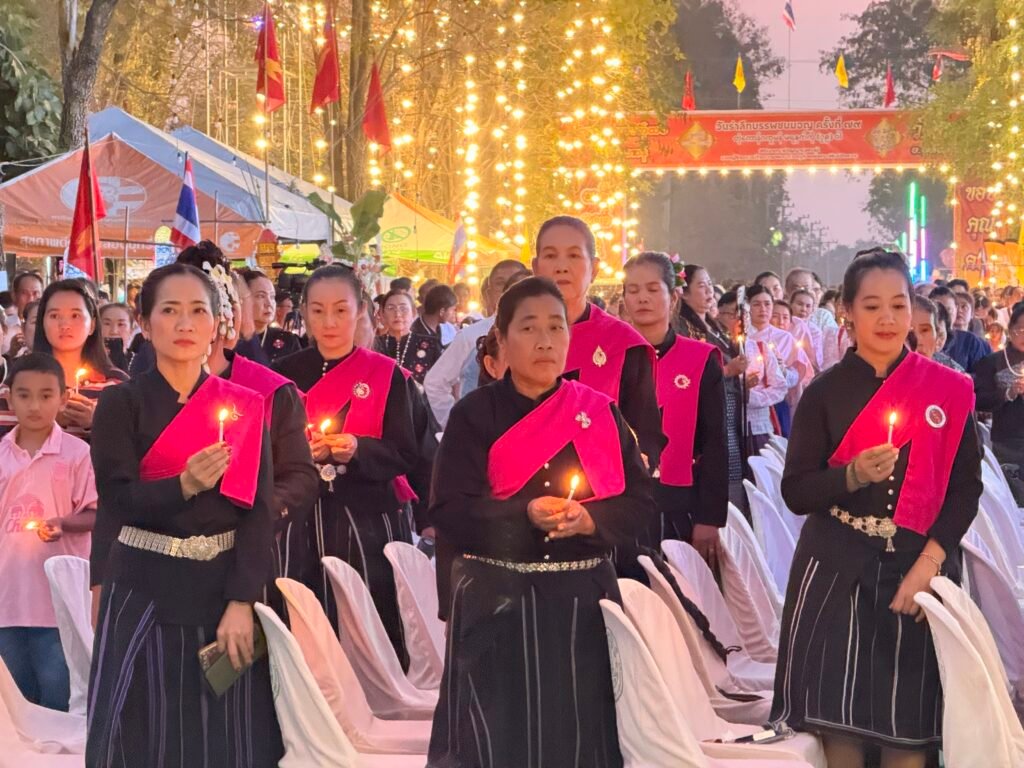
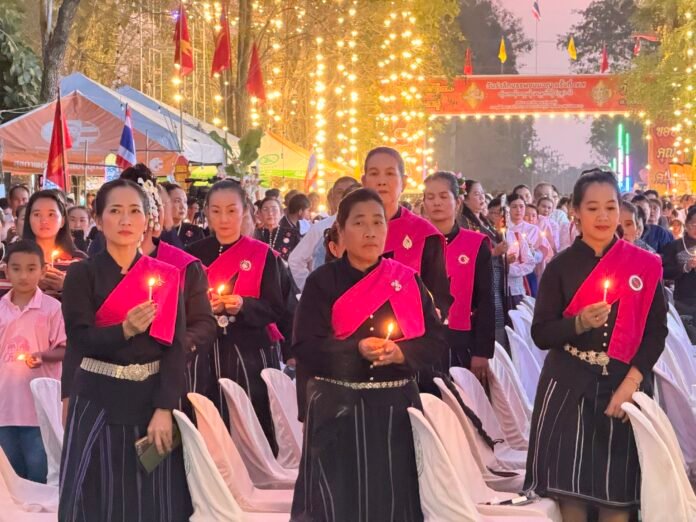
On the first night of the Mon National Day celebration, the entertainment program featured Thai/Mon dance troupes from various regions of Thailand. Each group performed gentle and graceful dances that embody the essence of Buddhism—forms that Mon communities from the Hanthawaddy region have largely ceased to preserve.
Together with the Thai-Mon dance troupes, our own group responsibly participated in the performance programs from the first night of the 79th Mon National Day through to the flag-raising ceremony the following day.
At the event, we could hear Mon being spoken among migrant Mon workers from various regions, dance troupe members, and local vendors.
According to a Thai-Mon woman attending the event, local Thai-Mon communities in Suphan Buri—like other minority groups in Thailand—have increasingly adapted their education, employment, and lifestyles to fit into the mainstream of Thai society. As a result, the use of their own ethnic language and literature has become quite rare.
“My children and grandchildren can’t really speak it anymore. At home, I’m the only one who speaks Mon. Everyone else speaks the language they’re used to from school. I can’t read Mon script either—I can only speak it a little.”
She added that although she is skilled in vocal arts and wishes to pass her knowledge down to future generations, language barriers prevent her from transmitting it within her family.
Despite the weakening of language and literature, Mon animist traditions continue to survive. This is evident in the spirit shrines built in front of houses throughout Suphan Buri.
Our newfound host explained that Mon families still worship Mon spirits today.
“We Mon people worship spirits. We still hold spirit ceremonies. Each household has its own spirit. Most ceremonies are held during the month of Kasone. Families who worship the Turtle Spirit (also called Leik Pote) do not worship other spirits.”
As many Mon families primarily engage in agriculture, traditions of worshipping nature spirits associated with fields and farms also remain.
According to records from the provincial immigration authorities, Suphan Buri has a population of around 848,000. In addition to Thais, ethnic minorities such as Mon, Lao, Chinese, and Khmer also reside there.
Historical records note that Suphan Buri has deep connections with the Mon people. It was once a major center of the ancient Dvaravati civilization, which was largely established by the Mon. The name “Suphan Buri” is also said to derive from Suphannabhum or Suvarnabhumi (“Golden Land”), and the area was among the most important regions inhabited by the Mon during the Dvaravati era.
Today, however, Mon communities have largely assimilated into Thai society, with most identifying themselves as Thai.
Beyond concerns over the declining preservation of language and literature, efforts to strengthen cooperation on future Mon ethnic affairs have begun. To mark the 79th Mon National Day, Mon people from Thailand and from the Hanthawaddy Mon region met and formed a Thailand–Myanmar Mon Coordination Committee at the Mon monastery in Suphan Buri town where we stayed.
It is understood that Mon communities in both countries will work together more actively on broader Mon ethnic issues.
Unlike previous annual celebrations, the recent 79th Mon National Day stood out as a particularly meaningful occasion. Mon people from both the Mon regions and Thai-Mon communities collaborated on constructive initiatives for their ethnic future. Having witnessed this firsthand and been able to take part to some extent, the trip felt like one where devotion and opportunity came together.
Based on what we were able to observe, this article presents the Thai-Mon communities we encountered, as well as the remaining traces of Mon history, culture, and traditions still found in Suphan Buri Province.