Network Media Group
The skies over northern Myanmar are bleak, shrouded not only by the winter cold but also by the smoke of the military council’s artillery.
While winter in the north is bitterly cold, political tensions remain high in several cities across northern Shan and Kachin States.
The military council is forcing the final phase of a three-stage election across the country, seeking to use it as a political outlet.
However, on the ground, one does not hear the voices of voters or the footsteps of citizens heading to the polls.
Instead, there is only the rumble of artillery in Hpakant and a haunting silence on the dry, deserted roads of Kyaukme and Hsipaw.
This silence serves as a testament to the people’s silent resistance against the military council’s forced elections.
Northern Shan State’s Deserted Polling Stations and ‘Lack of Representation’
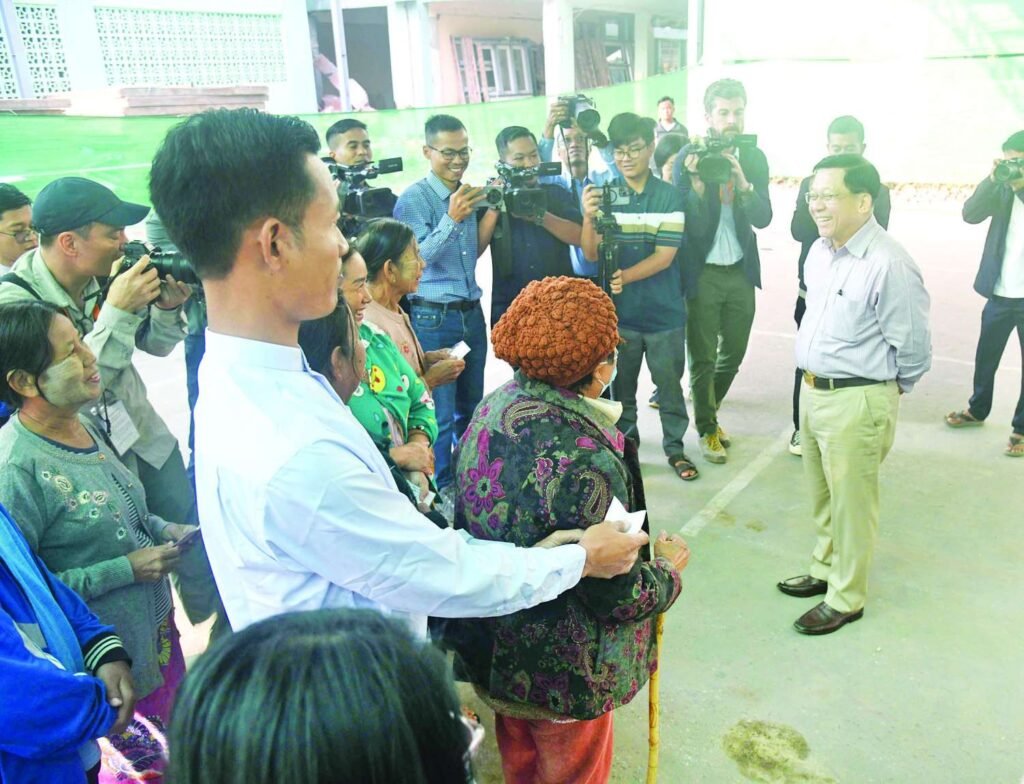
The elections held in Kyaukme and Hsipaw townships—the heartlands of northern Shan State—will go down in history as ‘unrepresentative.’
Kyaukme Township comprises 81 village tracts, yet the military council was only able to open polling stations in nine urban wards and five village tracts.
This accounts for a mere 6 percent of the township, leaving the remaining 94 percent of residents without a voice.
A source close to the Shan Nationalities Democratic Party (SNDP) commented on the situation:
“The villages where the Shan ethnic majority live were not included in the current election. Therefore, this election is neither representative nor fair for the local population.”
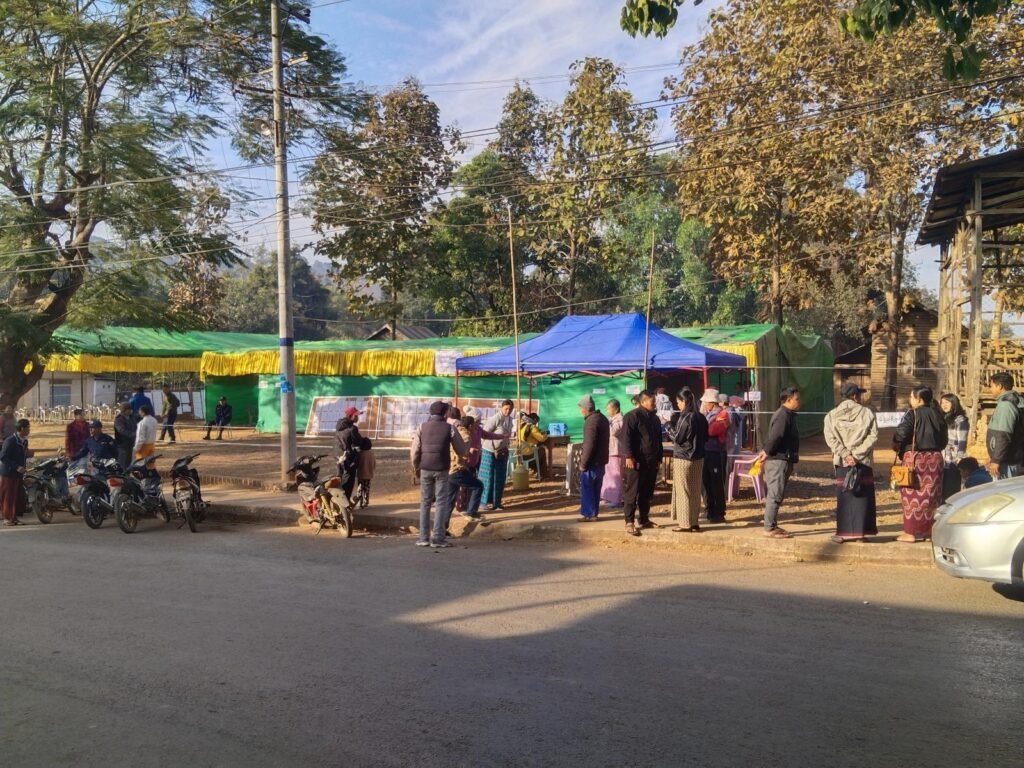
A resident of Kyaukme described the reality at the polling stations:
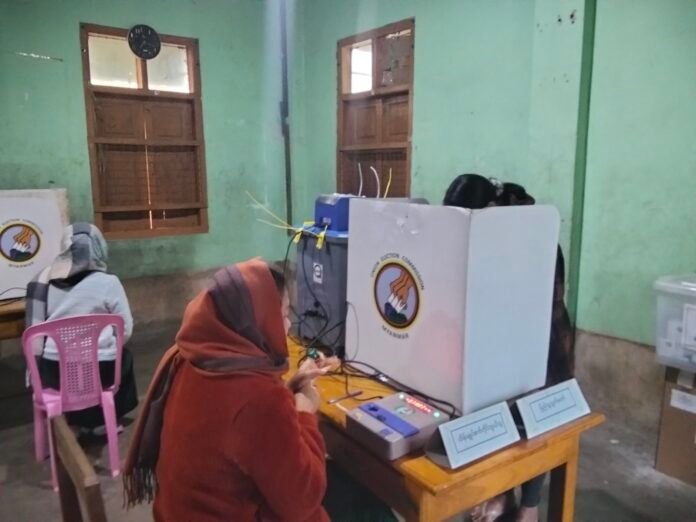
“In the city, voters were barely visible. Only one or two people showed up until the polls closed. The military claimed over 50,000 voters, but in reality, the stations were empty. People were more concerned about security than voting.”
Specifically, villages with a majority Shan population remained outside the military council’s control and were excluded from election zones.
Despite the military council’s propaganda claiming over 50,000 participants, the actual polling stations remained vacant.
According to a Kyaukme resident, only a handful of voters appeared before the polls closed, as the public prioritized safety over the ballot.
In Hsipaw, voter turnout was similarly low, and the Union Solidarity and Development Party (USDP) won the election unopposed.
A Bloody Election Amidst the Sound of Hpakant’s Artillery
In Hpakant, Kachin State, the election was far from peaceful, marked instead by civilian bloodshed.
The military council had been blocking the entrances and exits to Hpakant since January 23 to facilitate the vote.
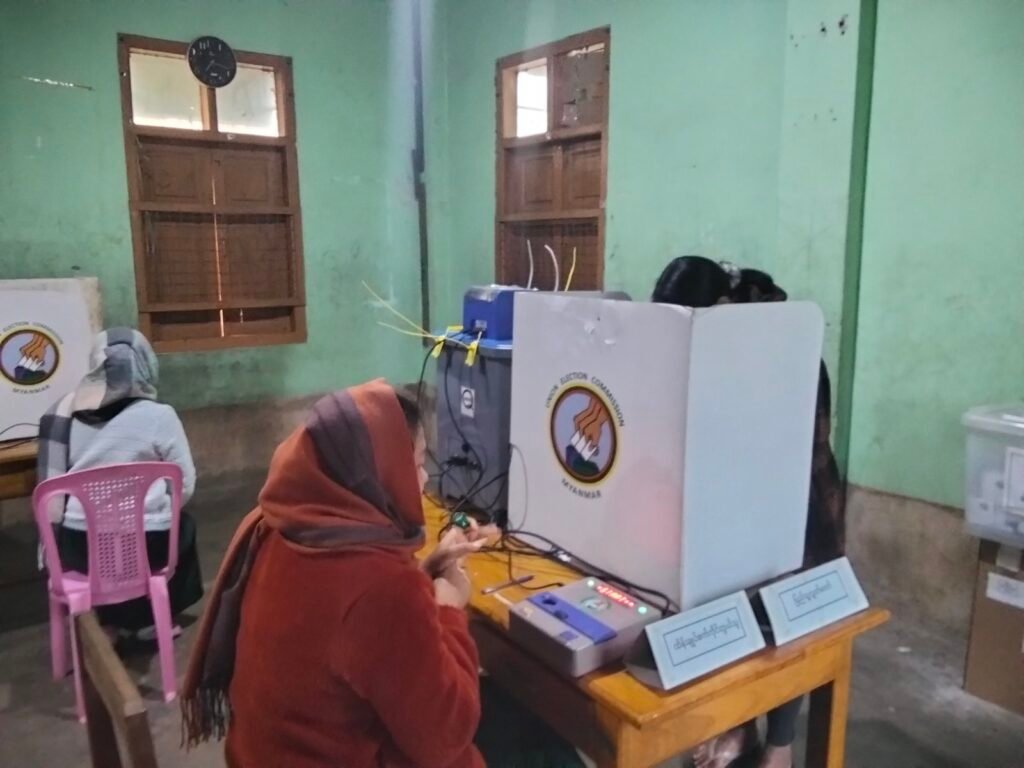
Regarding the situation on the ground, a Hpakant resident said: “The polling stations are open, but no one in the whole town has gone to vote. People are staying indoors. Outside, we can hear the sound of artillery fire—who would dare to go? We only see the staff voting among themselves.”
Beginning on the morning of January 25, at least five civilians were seriously injured by heavy artillery fire launched from the Hpakant military base and police station.
“The artillery shells landed in urban areas—one in Taungpyo village and two in Seikmu. There were also hits within the city, injuring at least five people. Three of them are in serious condition and are currently in surgery,” said a volunteer on the ground.
Another resident described the military’s pressure: “Since morning, artillery shells have been hitting one after another; even the houses are shaking. No one dares to go out because the shells are hitting areas where elections are held. Soldiers are waiting inside schools with guns.”
The military council blocked bridges leading into the city and deployed heavy security, yet only a few staff members were present to vote.
During the election, artillery shells struck homes in the Ngaungpyo Taw and Myoma neighborhoods.
At least five civilians were seriously injured, some in critical condition.
This reality highlights the discrepancy between the military council’s claim of a ‘peaceful and calm’ vote and the actual situation on the ground.
Elections Without the National League for Democracy (NLD)
At the time of the 2021 military coup, Myanmar was governed by the Government of the National League for Democracy (NLD) party.
The NLD had won landslide victories in the 2015 and 2020 elections, including in ethnic areas, except for Shan and Rakhine States.
However, the NLD did not participate in the current elections, resulting in a loss of the most significant right to representation.
The primary reason for the NLD’s absence was that the Union Election Commission (UEC), appointed by the military council, dissolved the NLD as a political party.
On March 28, 2023, the military council announced the dissolution of 40 parties, including the NLD, for failing to re-register under the “New Political Party Registration Law.”
The NLD responded by asserting that the military council is not a legitimate government and they are not obligated to comply with its laws, maintaining that the elections would not be fair.
Many party offices across the country, including the NLD headquarters in Yangon, were subsequently raided, sealed off, or bombed.
The exclusion of the NLD demonstrates that political parties are losing their right to representation in ethnic regions.
The “Made in China” Election
Activists point to China as the silent force behind this election.
San Htoi, campaign manager for the Kachin Women’s Association-Thailand (KWAT), described it as follows: “Looking at this election, it is ‘Made in China’—or even an election made by China. They are pressuring to revive the Myitsone Dam project in Kachin. It’s an exchange; therefore, we can call it a ‘Made in China’ election.”
Sai Muang, editor-in-chief of the Shan Herald Agency for News (SHAN), also assessed China’s interference: “From what Deng Xijun said, China is pushing Myanmar to hold an election, going beyond its own policy of non-interference. The coup leader himself is showing that he is holding an election despite being unprepared.”
Election observers and activists have labeled the process a “Made in China Election,” alleging that China is pressuring the military council to hold the vote to revive its Belt and Road Initiative (BRI) and Myitsone Dam projects.
According to Deng Xijun, China’s special envoy for Asian affairs, the election is a combination of China’s direct interference and the military council’s search for legitimacy.
Expected to Intensify Post-Election
Despite the election, the conflict in Myanmar shows no signs of abating.
Revolutionary forces have warned that this election is not a step toward peace, but the beginning of a larger conflict.
Khun Thomas, a representative from Karenni State, assessed the future: “I believe that even after the election, there will be no de-escalation.
Our revolutionary side is preparing for a stronger offensive. Therefore, we expect even more intense and widespread conflicts.”
Revolutionary forces have stated they will not recognize the election results and are mobilizing strategically to overthrow the military dictatorship.
Tin Tin Nyo of the Women’s League of Burma (WLB) spoke on the public’s will: “The conviction that this Spring Revolution must end this dictatorship remains strong. Regardless of the results, we must continue to fight until the military dictatorship falls.”
Ballot Boxes Under Threat and the Prospect of a Bloody Aftermath
The military council used various methods of coercion to force participation.
It threatened those who did not vote, burned down homes, and restricted travel. Human rights violations—such as threatening to burn the homes of displaced persons if they do not return, or banning young people from university if they do not vote—have been blatant.
KWAT’s San Htoi added: “They may connect with international partners to reopen economic channels, using that revenue to fuel more conflict in ethnic areas. That is why this election is so critical. We foresee more conflict and more killing in its aftermath.”
The military council’s recent election is not a solution to Myanmar’s political crisis, but an attempt to extend the term of military leaders by exchanging the country’s sovereignty and resources for Chinese support.
The public continues to struggle for survival under the constant threat of airstrikes and artillery.
The election is not only illegitimate but lacks popular representation.
It ignored the will of the people and cost many lives.
Observers believe that results built on injustice will only plunge Myanmar into a deeper war.
With more artillery shells on the ground than ballots in the boxes, this election is not a way out, but a gateway to intensified conflict.
The international community is urged not to recognize this ‘sham election’ and to support only the revolutionary organizations establishing genuine governance mechanisms on the ground.