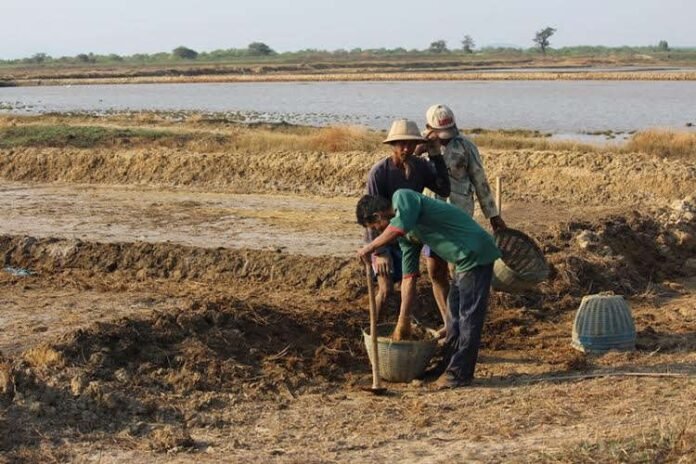
Salt farmers across Mon State say they have been unable to produce salt this season because frequent, unseasonal rains continue to damage their salt fields, forcing them to repair the fields again and again.
Farmers report that since September, they have already carried out repairs three times, spending more money each time while earning nothing in return.
A salt farmer from Thanbyuzayat Township said heavy rains regularly flood the salt fields, reducing the salinity of the seawater and damaging the earthen pans.
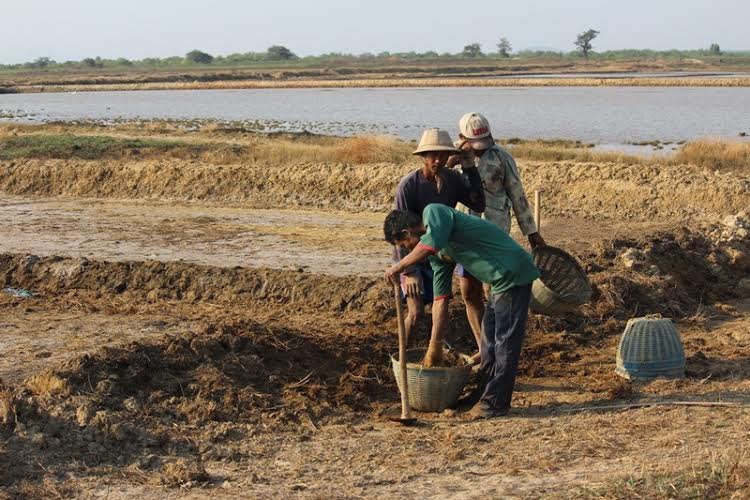
“Whenever we finish preparing the fields, the rain comes and the water loses its salt concentration. The fields get damaged, and we must start over. The salt can’t dry under the sun yet. We still have to pay workers, so the costs keep increasing. Since September, we’ve repaired the fields three times, and it’s still raining,” he said.
Farmers say their yearly investment, meant for an entire salt production season, is now being drained by repeated repair costs before they can even begin drying the seawater.
According to the Department of Meteorology and Hydrology, cloud formation remains strong across Mon State, and scattered showers are still expected.
Salt producers warn that unpredictable weather this year has caused major losses, and the 2025 salt-drying season may be the worst they have faced in years.
Although Mon State typically begins salt production in December, farmers say continued rainfall could delay or even halt production entirely.
“We are watching the weather every day. If the rain stops before the end of November, we might be able to produce salt by late December. But if the rain continues, it will be very difficult for farmers to continue working,” a Thanbyuzayat farmer said.
Farmers also say that while a salt field can normally produce up to 15 batches of salt in a good year, early rains last year allowed only about eight batches, cutting production nearly in half.
With low stock from last year and no new salt produced yet this season, the price of raw salt has already risen to more than 1,000 kyats per viss, reaching a record high.
As a result, salt producers warn that in the future, only a few small-scale farmers may be able to continue operating in the industry.