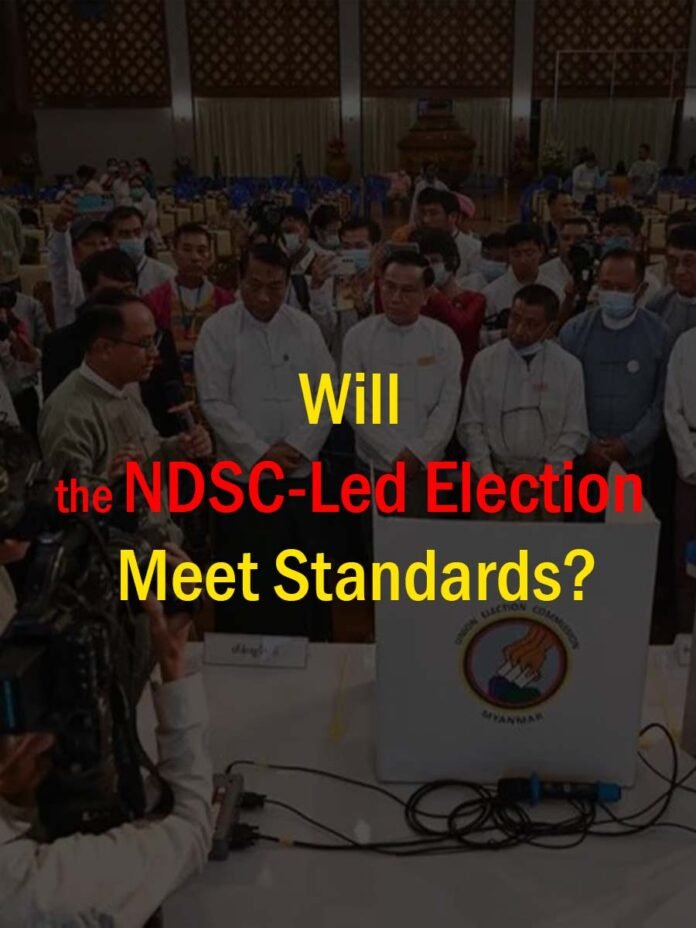
Observers argue that a fundamental standard of any election is that it must be free, fair, and independent of coercion or manipulation.
Following claims of voter fraud in the November 2020 general election, Myanmar’s military—using that justification—seized power and is now planning to hold a new election.
Senior General Min Aung Hlaing, the junta leader, announced on July 30 that a new election would be held in December 2025 during a formal meeting.
Since then, the military has dissolved the previously formed State Administration Council (SAC) and established a new National Defense and Security Council (NDSC), which is now forming interim governments and a new election commission.
“Let’s put aside the idea that the election must be all-inclusive. The people organizing this election are the same ones who, under Article 419, took control of all three branches of power—legislative, judicial, and executive—since the coup. Now they’ve formed an election commission the way they want. In such a context, we can’t even use the term ‘free and fair’ anymore,” said an election observer.
The NDSC includes the country’s acting president and key military leaders, including the Commander-in-Chief. As Senior General Min Aung Hlaing currently holds the position of acting president, he also chairs the NDSC and holds authority over all three branches of government until after the election.
Under the NDSC’s approval, a new Union Election Commission was reconstituted on July 31, with U Than Swe appointed as the new chairman.
“Throughout different eras, most members of the election commission have been individuals transferred from the military. Since 2010, the commission has been formed, and people like General U Tin Aye and others have been there. Even under the NLD government, though U Hla Thein was appointed, the secretaries were all from the military. U Than Swe might also be someone who transitioned from the military to a civilian role. That hasn’t been confirmed yet. But what’s certain is that this commission will also include individuals transferred from the military,” said observer Ko Aye Min (pseudonym).
Although only six months remain before the planned election, the military has yet to regain control of more than 90 towns nationwide. In cities like Yangon, former military officers and junta supporters continue to be targeted and killed.
Revolutionary groups have publicly vowed to oppose the junta-led elections by any means necessary, raising serious security concerns among political parties.
However, the junta seems unfazed. It has issued an “Election Protection Law” to ensure the election is held. According to a law issued on July 29, anyone who criticizes or disrupts the election could face a minimum of three years in prison and, in cases involving fatalities, the death penalty.
This law applies during the entire election period, from campaigning to post-election result announcements.
“From a legal perspective, this new law is unnecessary. Existing criminal laws already outline penalties for election-related crimes, and the election commission law also covers those. What’s different is that the punishment fits the crime under the older laws. But under this new law, it’s all extreme—imprisonment or death. This isn’t law; it’s just intimidation disguised as law,” said lawyer U Myint Maung, a legal expert.
During a 2024 meeting between the National Solidarity and Peace Negotiation Committee (NSPNC) and 52 political parties, discussions were held about allowing party members to carry arms during the campaign period. Reports also emerged that the Union Solidarity and Development Party (USDP) had submitted advance voter lists ahead of the campaign.
“If someone shows up to vote while visibly armed, it’s intimidating. People are afraid of guns. So, even if they vote, they’ll do it in fear,” one political figure remarked.
The junta has also announced that it will introduce electronic voting for the upcoming election. However, observers question the system’s reliability and transparency.
“People think e-voting is simple. But for election rigging, it might be the best tool. With paper ballots, if something looks wrong, even an MP can request a recount. With e-voting, once the button is pressed, there’s no way for the public to verify. There’s no mechanism for requesting a review,” said an election observer, Ko Aye Min (pseudonym).
As of now, 77 political parties have registered to compete, and 54 have received official party registration from the election commission.
Notably absent among the 54 are the National League for Democracy (NLD) led by Daw Aung San Suu Kyi, and the Shan Nationalities League for Democracy (SNLD), which are both historically popular and influential.
Daw Aung San Suu Kyi remains detained by the junta. On July 28, the junta also declared that any party found guilty of election fraud would be permanently banned from political participation.
Given the exclusion of key stakeholders, the military’s grip on the election process, and threats of imprisonment or death for dissent, observers say the upcoming election cannot be considered inclusive, free, or fair.