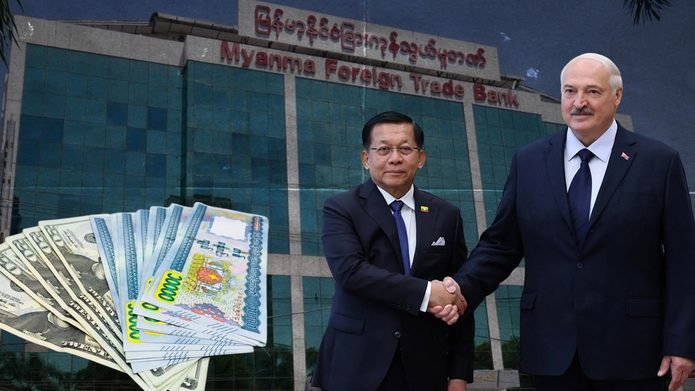
The military council’s financial situation, marked by a record budget deficit of more than 11 trillion kyats and plans to borrow substantial sums directly from the Central Bank of Myanmar, highlights the underlying realities of the country’s economy.
More than five years after the military coup, the financial management of the military commission’s administration is facing one of its most severe crises, with the budget deficit reaching a record high.
In the last fiscal year before the coup, 2019–2020, the government’s budget deficit stood at approximately 6 trillion kyats.
At a parliamentary session on October 16, 2026, Deputy Minister of Finance and Revenue Daw Than Than Lin, appointed by the military, said the projected budget deficit for the 2026–2027 fiscal year had initially been estimated at 9,015.181 billion kyats. However, following requests for additional appropriations, the revised estimate had risen to 11,418.878 billion kyats.
The Roots of the Deficit
The aftermath of the military coup, escalating conflict, rising military expenditure, and international economic sanctions have placed the military leadership under mounting pressure to finance its annual budget deficit.
Although the military leadership does not publicly disclose defense spending—in other words, military expenditures—it is easy to surmise that it accounts for the largest share of government spending.
Furthermore, following the coup, international sanctions triggered a shortage of US dollars and made it difficult to conduct financial transactions through international banking networks.
“When the United States, Europe, and other Western countries imposed sanctions, the military-controlled Myanma Foreign Trade Bank (MFTB) and Myanma Investment and Commercial Bank (MICB) lost their connections to international financial networks. International institutions such as the World Bank and the Asian Development Bank (ADB) also stopped providing grants and loans to the military. As a result, the state treasury lost its sources of revenue, leaving it with expenditures but little income,” a financial expert explained.
Under the previous civilian government, several major sources of revenue helped cover the budget deficit, including border trade taxes, foreign investment, and access to low-interest international loans. These sources were also disrupted by the military coup.
To cover the deficit, the military authorities have approved plans to borrow more than 2,100 billion kyats directly from the Central Bank of Myanmar.
Following the decision, reports emerged that the military authorities would print new banknotes, while the kyat continued to depreciate in international foreign exchange markets.
Economic analyst U Thet Zaw said, “The Central Bank cannot simply decide on its own to print new banknotes. It is only allowed to print the amount authorized by the government. What I mean is that borrowing money does not automatically mean that new banknotes will be printed every time.”
The Burden of Domestic and External Debt
According to financial statements for the 2024–2025 fiscal year, Myanmar’s outstanding domestic and external debt exceeded 70 trillion kyats.
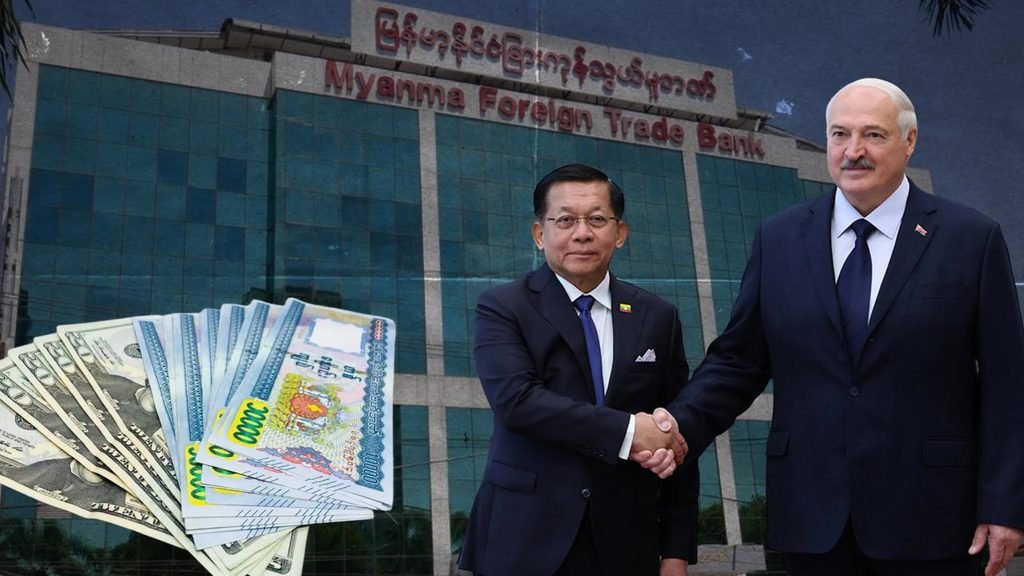
Against this backdrop, parliament has also approved a proposal to obtain an export credit loan from Belarus at an interest rate of more than 9 percent.
The loan is intended to finance purchases of Belarusian industrial equipment and technology on credit, with repayment required alongside interest.
The proposal was submitted to parliament at the direction of coup leader and President U Min Aung Hlaing. Although economists warned that the loan could increase the country’s debt burden, parliament approved the borrowing.
U Thet Zaw said, “An excessively high interest rate can become a burden. Once a loan is approved, who bears the impact of that debt? The public does. When we consider the national debt in relation to the country’s population, the obligation to repay it ultimately falls on individual citizens.”
The Myanmar kyat has also depreciated significantly. Before the coup, in 2020, one US dollar was worth approximately 1,300 kyats. By 2026, the exchange rate had fallen to around 3,600–4,000 kyats per US dollar.
The depreciation of the kyat has had a direct impact on people’s daily lives.
Prices of basic food items, including rice, cooking oil, and salt, have risen to nearly five times their pre-coup levels. Many people are struggling even to purchase these essentials in the quantities they need.
The military leaders who seized power are now governing the country through a military-led administration. However, whether they can effectively manage the requested budgets and address the continuing depreciation of the kyat remains an open question.