By Min Saw Hai
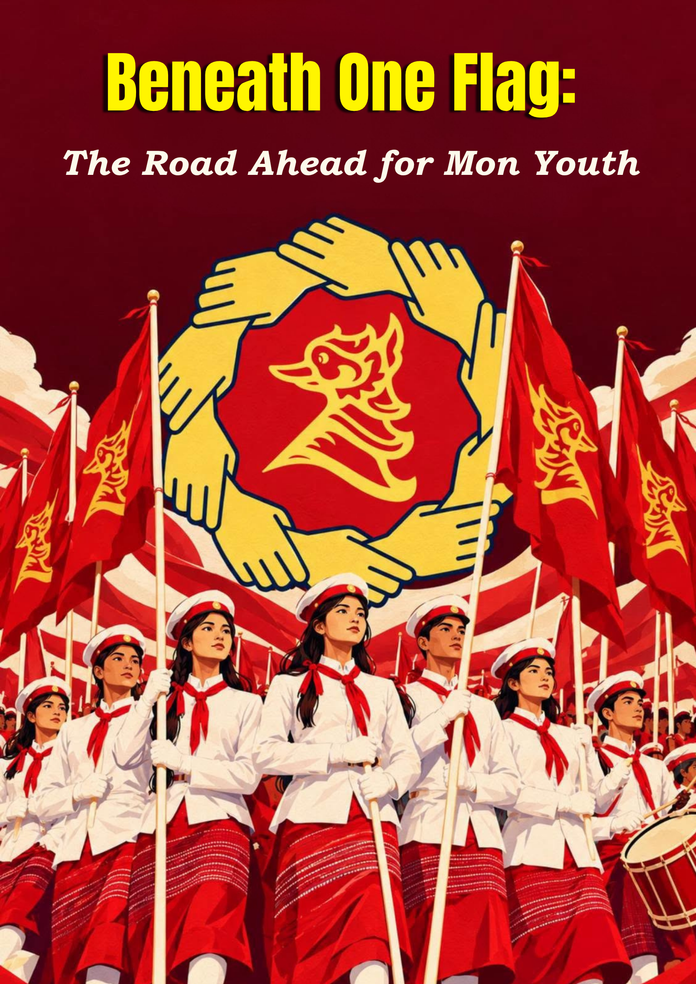
A conference that brings Mon youth together should do more than gather people from different places and backgrounds. It should create space for young people to share their perspectives, reflect on the challenges they face, and collectively determine how to move forward. A flag can carry many meanings, but what matters most is what people stand for beneath it.
The Mon Youth Forum (MYF) has announced that the Fourth Mon Youth Conference will take place on October 17–18, 2026, at the Ko Yin Lay Pagoda Missionary Area in Ye Township.
The conference aims to assess the current situation of Mon youth, exchange perspectives, review MYF’s activities over the past two years, evaluate the Mon Youth Policy and strategy, set priorities for the future, and elect new officeholders.
Achieving these objectives requires connecting the realities of young people’s lives with their right to participate in decision-making. Two documents offer important perspectives for these discussions: an assessment by the Mon Youth Progressive Organization (MYPO) and an open letter from the New Rehmonnya Federated Force (NRFF).

Understanding the Challenges Facing Mon Youth
In Issue No. 2, published on August 31, 2026, MYPO released an assessment titled “Access to Justice for Mon Youth Amid Political Crises.”
The assessment examines the arrests, prosecutions, and imprisonment of Mon youth amid the political changes that followed the military coup. Drawing on news reports and internal case records, it documents reported incidents and presents evidence of the challenges young people have faced.
One key finding is that young people face risks not only because of their political activities but also through their everyday movements and digital communications. The assessment describes cases in which young people were reportedly accused of communicating with certain organizations and subsequently arrested or prosecuted on the basis of photographs, messages, and social media records found on their phones.
The report also examines drug-related cases, the difficulties faced by young migrant workers, and disparities in access to assistance based on financial circumstances. It raises concerns about detainees being transferred to interrogation centers, restrictions on access to lawyers and family members, prolonged detention, and unfair legal proceedings.
Conditions in detention are another major concern. The assessment describes inadequate access to medicine, medical treatment, food, and other basic necessities, as well as reports of torture and discrimination.
In response, MYPO recommends that Mon revolutionary forces take steps to protect young people’s personal information, civil society organizations adopt security policies, and young people improve their digital security awareness and exercise greater caution when traveling. It also urges parents to maintain communication with their children and help protect them, while calling on international organizations to explore ways to provide effective assistance.
Despite changes in the political landscape, the assessment underscores the persistent barriers Mon youth face in accessing safety and justice.
NRFF’s Concerns About the Conference and Youth Issues
While MYPO focuses on the practical challenges facing young people, NRFF raises concerns about the conditions under which these issues will be discussed at the conference.
In an open letter dated October 17, NRFF welcomed the conference’s objectives but expressed concern about participants’ safety and their freedom to speak openly, given that the event is being held under the authority of the military regime.
NRFF also argued that the absence of Mon youth from revolutionary forces opposing the military regime could limit the conference’s ability to represent the wider Mon youth population.
The letter further called for greater attention to threats to young people’s lives and safety, displacement, and the pressure on families caused by what it described as the “forced conscription law.” These issues, it argued, should be discussed alongside education, healthcare, and employment, with the ability to live with dignity also recognized as a key concern for young people.
The letter also raised allegations of human rights violations and serious international crimes attributed to the military regime, calling for discussions on accountability and possible action. It concluded that authoritarianism obstructs both Mon national liberation and youth development, urging young people to unite and work together against authoritarian rule.
Although MYPO and NRFF approach these issues from different perspectives, both highlight the importance of young people’s safety, rights, and meaningful participation in decision-making.
Turning Policy into Action
Every Mon young person should have access to the Mon Youth Policy, and the document should be presented in a clear, accessible format. Those responsible for reviewing it must first study its provisions carefully to understand what the policy entails.
The draft policy consists of three chapters. Chapter One outlines its vision, objectives, strategic direction, definition of Mon youth, and guiding principles. Chapter Two covers 11 major areas: politics, education, health, social affairs, the economy, literature, peace and security, music and the arts, drugs, regional development, and land, the environment, and natural resources.
Given the rapid development of artificial intelligence, a separate section on “Youth and Technology” should also be considered. Technology has direct implications for young people’s education, employment, and security, as well as the development of Mon literature.
Chapter Three sets out the principles governing implementation. Article 17 identifies the Mon Youth Policy as the overarching policy framework for the entire Mon youth population. Accordingly, the participation of diverse youth groups should be prioritized when the policy is reviewed and revised.
Article 18 outlines the organizational structure of the Mon Youth Forum. As new officeholders are elected at the conference, their roles and responsibilities should be clearly defined in accordance with this structure.
Article 19 states that Mon Youth Day should be celebrated at a single location within the country to promote unity, while Mon youth living abroad may organize celebrations according to their circumstances. The large-scale Mon Youth Day celebration organized by Mon youth in Malaysia is one example of an event held overseas. This provision acknowledges the different circumstances of Mon youth living at home and abroad.
Article 20 establishes that Mon youth are responsible for implementing the policy, individually or through their respective organizations. The policy review should therefore examine not only what needs to be revised or added but also how effectively its existing principles have been put into practice.
The policy also calls for cooperation with other ethnic youth groups that share similar objectives and aspirations. It emphasizes collective responses to natural disasters, conflict-related emergencies, and human-caused disasters that threaten Mon national interests. These principles need to be translated into practical initiatives that address the challenges young people face today.
Against this backdrop, MYF’s report on its activities over the past two years is particularly important. The report should clearly outline the activities undertaken, the results achieved, the work left unfinished, and the challenges encountered. An honest assessment of these experiences would help the newly elected officeholders develop a more realistic and effective work plan for the 2027–2028 term.
Inclusive Participation Must Guide Decision-Making
Building a strong collective movement requires listening to different perspectives. The contributions of those who can attend the conference should be valued, but the views of those who cannot attend must also be sought. It is essential to identify which groups are represented and which remain excluded.
At the 2025 Mon National Conference, recommendations were made on the draft constitution of Ramanya Mon State. However, the draft was not adopted, and the recommendations were retained only as records of the discussions. This experience offers an important lesson: decisions affecting an entire people should not be rushed when some groups have been unable to participate.
The Mon Youth Conference may likewise generate valuable discussions. However, meaningful discussion does not automatically confer the authority to make decisions on behalf of the entire Mon youth population. When participation remains incomplete, policy decisions should not be rushed through for formal adoption.
If necessary, an inclusive joint committee could be established to oversee policy revision and strategy development, with clearly defined responsibilities and a specific timeframe. The committee could identify and implement activities within its existing mandate while continuing consultations on issues that require broader consensus.
The Road Ahead for Mon Youth
Discussions about the collective strength of Mon youth should recognize both their historical contributions and their responsibilities today. Throughout history, Mon youth have played a role in political change within the Mon community. Their efforts helped initiate the Mon revolution. They also mobilized opposition to the proposed Ann Din coal-fired power plant project, which threatened the region’s natural environment, and contributed to efforts to unite Mon political parties.
Building on this history, Mon youth should renew their efforts to unify Mon armed forces. They need to consider how discussions on unification can begin, how common goals can be identified, and what role young people can play in the process.
At the same time, young people involved in the Mon revolutionary movement need to reflect critically on whether their time and efforts are being used to advance other people’s interests. They should ask whether they have decision-making authority commensurate with their responsibilities, whether their recommendations are taken seriously, and whether their contributions lead to meaningful results.
For collective participation to be sustained over the long term, it must carry real weight in decision-making.
The Fourth Mon Youth Conference should produce practical initiatives that respond to young people’s actual needs, broaden participation in decision-making, and establish accountable leadership. The significance of gathering beneath one flag lies not simply in coming together, but in addressing shared challenges and shaping a common future.
Ultimately, the Mon youth who helped initiate the Mon revolution still have a responsibility to help bring it to an end.