Most political analysts say there is little prospect of Myanmar making progress during the five-year term of the transitional government led by coup leader Min Aung Hlaing.
Over the five years since the military coup, Myanmar has experienced deterioration and destruction across various sectors, including politics, peace processes, the economy, healthcare, and education.
A Mon politician told IMNA that international investment is unlikely to return to the country in the near future and that there has been little progress in the peace process.
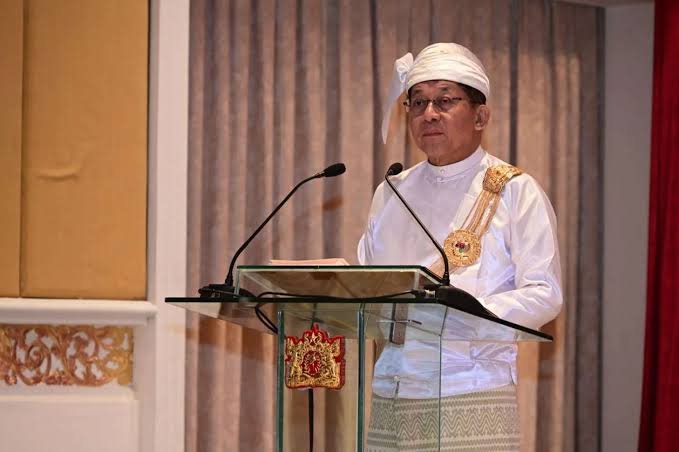
“Regarding the situation over these five years, I don’t really see any significant changes yet. I think, especially when looking at the economy, we are not receiving much international investment or investment from neighboring countries like we did during the U Thein Sein era. I don’t think investments will come in during these five years either. So, I don’t see any prospect for economic growth. That is one point. Also, I don’t see much significant progress or change in the peace process like during the U Thein Sein era. Whatever one may say about that period, they met and held discussions with some EAOs, reached agreements at the state level, and eventually worked toward the NCA at the Union level. I don’t see this five-year term making that kind of progress or change either.”
He added that ongoing armed conflicts in the country have resulted in human rights violations and that there is little prospect for improvements in stability and other related issues.
After assuming the presidency following a controversial election, Min Aung Hlaing traveled to neighboring countries, including India, China, and Russia, to invite investment in Myanmar.
A Kachin politician told IMNA that commodity prices have risen sharply, while imports and exports are facing difficulties. The politician also said there is a lack of transparency in political and economic affairs.
“It is difficult to predict. We have not yet seen any clear policies. We have not seen anything clearly laid out about what they intend to do. We see him traveling internationally, but that is about all. Domestically, we also have not seen any concrete efforts toward peace. During U Thein Sein’s time, when they talked about peace, the parts of the peace process that he worked on were carried out to some extent. Under Min Aung Hlaing’s government, we have not yet seen any concrete peace efforts. As for the economy, under the current circumstances, commodity prices are rising, and imports and exports are facing difficulties. So, in terms of the economy and politics, we have not yet seen anything being carried out openly, nor have we seen transparency.”
More than five years after the military coup, armed conflicts have not decreased, with fighting continuing in various parts of the country.
Investors are reportedly avoiding Myanmar because of the lack of rule of law, unreliable electricity supply, inflation, and unstable policies amid ongoing armed conflict.
Meanwhile, competition for control of border trade routes between Myanmar and neighboring countries has also emerged among the military authorities and various armed organizations.
A Myanmar political figure told IMNA that the country is unlikely to see any progress or positive change during the five-year term of the government led by the military authorities and could instead deteriorate further.
“There is no reason for things to get better. They have never been good, and things were not good in the past either. The present is not good, and the future will be worse. What makes it worse is that they have aligned themselves with China and Russia. Although they are powerful countries, they also have their own problems, and they are not going to come and help us out of goodwill. We need to understand that they are acting in their own interests.”
The politician further said that corruption is taking place within the transitional government led by Min Aung Hlaing, from lower-level staff to senior officials, resulting in a lack of public trust.
According to a report released by ISP-Myanmar, more than US$28.7 billion in foreign investment entered the country between 2016 and 2020. Between 2021 and 2025, following the military coup, only more than US$7.4 billion entered the country. As a result, the total foreign investment received during the five years following the coup was less than the amount Myanmar received in 2016 alone.
Political analysts agree that during the five-year term of the transitional government led by Min Aung Hlaing, Myanmar has shown little sign of progress in politics, peace, the economy, healthcare, or education.