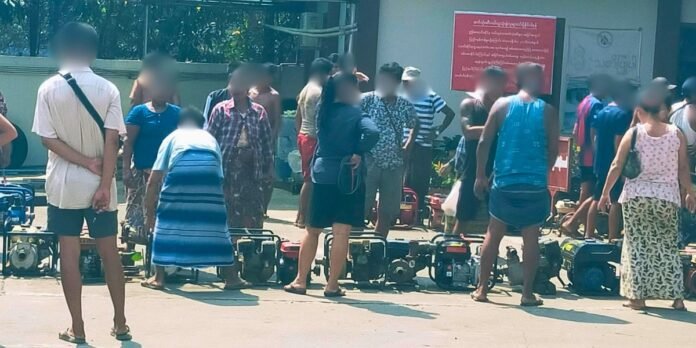
Farmers in Paung Township, Mon State, are queuing with irrigation water pumps to purchase fuel, according to local crop farmers.
Crop farmers are only allowed to purchase fuel if they bring their irrigation water pumps, according to notifications issued by village administrators and fuel station operators.
A betel farmer from Paung Township said that fuel is sold once a week under a quota system, with each machine allowed to purchase gasoline worth 10000 kyats.
“They don’t sell gasoline with recommendation letters or in containers to people working on farms. They only sell it if we bring the machines. But the amount they sell is very limited. It’s only enough to pump water for about an hour. If they sold it every day, it wouldn’t be a problem. Now it’s only once a week, and since we can’t get enough fuel, we can’t irrigate properly. The crops are drying out,” he said.
Fuel shortages are preventing farmers from irrigating crops, causing betel, durian, and other plants to dry out and suffer damage, with some unlikely to recover.
Currently, due to fuel shortages, major fuel stations in Paung Township are only open for sales two days a week.
Although summer paddy farmers are officially allowed to buy three gallons of gasoline per acre with a township administrator’s recommendation letter, fuel stations are only selling about one gallon per acre—roughly one-third of the set amount, according to farmers.
“Farmers are required to purchase fuel with a recommendation letter. We have 10 acres of farmland, and they should be giving us 30 gallons, but now we are only given 5 gallons. We won’t be able to harvest in time, and the rainy season is approaching. We can already hear frogs croaking, and hearing those sounds only makes us more anxious. There’s nothing we can do,” said a female farmer from Paung Township.
Due to difficulties in purchasing fuel, summer paddy farmers are unable to harvest on time. If the rains arrive, there is a risk that the quality of the rice will decline, leading to potential losses.
Farmers also say that rising agricultural costs, combined with a likely decrease in crop yields, could reduce their income and lead to difficulties in meeting their basic living needs.