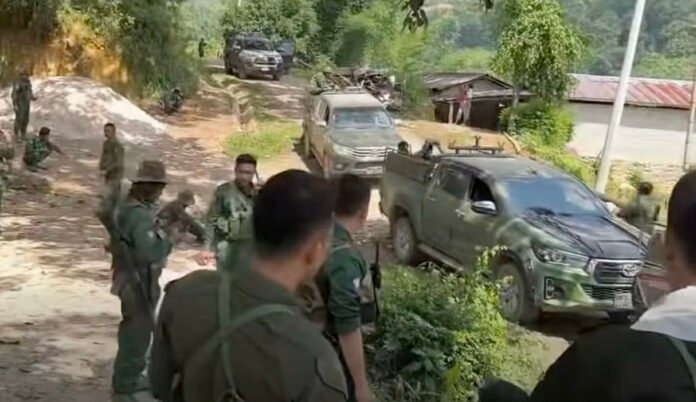
In Kutkai, northern Shan State, tensions have escalated into armed clashes between allied groups—the Myanmar National Democratic Alliance Army (MNDAA) and the Ta’ang National Liberation Army (TNLA).
The conflict began when the TNLA detained MNDAA troops stationed in Kutkai town and expelled them. In response, the MNDAA launched a large-scale offensive and seized control of Kutkai on March 15th.
Kutkai, where the two allied groups had disputed territorial control, is located along the Muse–Lashio Union Highway—a key route that the Chinese government is eager to see reopened as soon as possible.
According to local sources, the MNDAA approached the Kachin Independence Army (KIA) to request the removal of its checkpoints.
The day after capturing Kutkai, the MNDAA reopened the Muse–Lashio highway.
China–Myanmar affairs analyst Dr. Hla Kyaw Zaw commented “In my view, China is likely pressuring for these routes to reopen. China wants this road reopened quickly. They are preparing to start their projects this year. I understand this as a time when China will place greater focus on the landlocked economy of Yunnan.”
To de-escalate the fighting between the allied forces, senior leaders of the MNDAA and TNLA reportedly met in Laukkai on the morning of March 17th for discussions.
Kutkai played a crucial role as a logistics hub during Operation 1027 and has long been an important town along a major trade route, even during periods of relative calm.
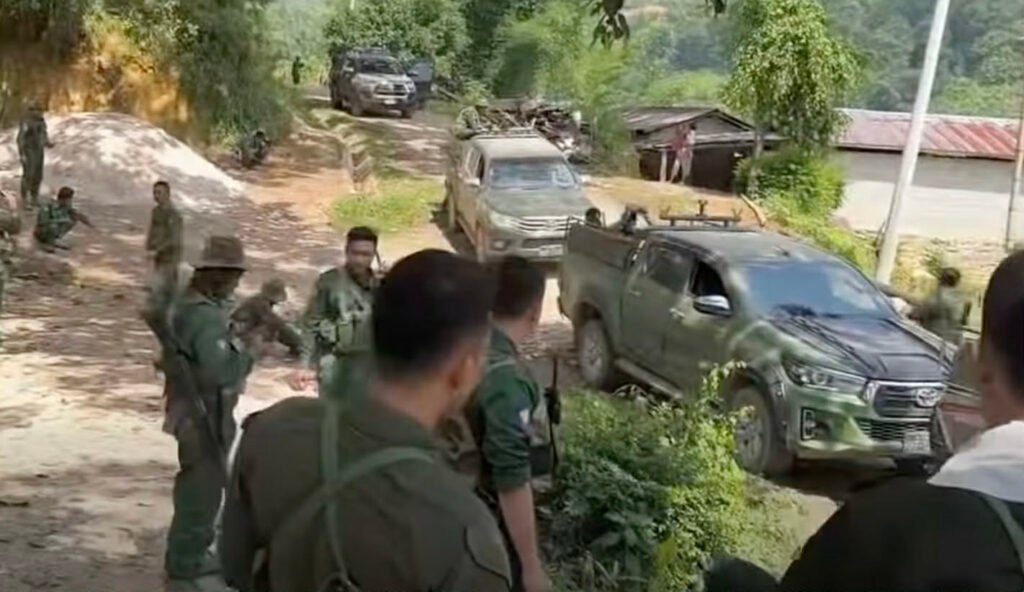
“Kutkai, you could say, had become like a huge arms market — almost like a weapons bazaar where groups from the lower regions came to buy arms,” said a People’s Defense Force (PDF) member who participated in the northern Shan conflict.
A source close to the TNLA said that months before the conflict erupted, representatives from the TNLA, the military, and China met in Kunming to negotiate the return of Kutkai and Namtu, but the talks failed.
A military analyst noted “China wants stability in northern Shan because it needs to conduct business. That’s why it pushed hard to make this election happen. China has tried to mediate between these groups, but it seems dissatisfied with the ongoing fragmentation. Another point is that the UWSA has remained silent. Although it’s said that messages were sent, there has been no response from the Wa side.”
The China–Myanmar railway project, planned to run from Kunming in Yunnan Province through Muse and Mandalay to Kyaukphyu, will pass through conflict-affected areas such as Kutkai and Namhpakka.
If completed, the project would give China access to the Indian Ocean while boosting economic development in landlocked Yunnan and helping balance nationwide economic growth.
The railway is estimated to cost up to USD 8 billion. Since the military coup, junta leaders have frequently spoken about implementing the project.
Although the railway is a long-term project that may take decades to complete, sources say China has already begun preliminary preparations and infrastructure work.
On the Myanmar side, preparations are also reportedly underway, including projects like the Namtu hydropower dam, which would supply sufficient electricity for the railway section passing through Hsipaw Township.
While it remains unconfirmed whether the tensions between allied groups are directly influenced by China, these areas are undeniably regions where Chinese strategic and economic interests are deeply involved.