Granting amnesty to prisoners is not an unusual occurrence. Although the junta has frequently granted amnesty to prisoners after seizing power, political prisoners have rarely been included.
However, the junta’s prisoner amnesty on March 2nd was remarkable. The reason is that among the prisoners granted amnesty, over 7,000 were political prisoners—making this the largest number of political prisoners released in the history of such amnesties.
The release of political prisoners close to the end of their sentences raises questions among political analysts and human rights activists about whether the junta is acting out of genuine goodwill or pursuing political objectives.
The PPNM (Political Prisoners Network of Myanmar) said the junta’s recent release of prisoners nearing the end of their terms may be connected to the formation of the next parliament and the establishment of a new government.
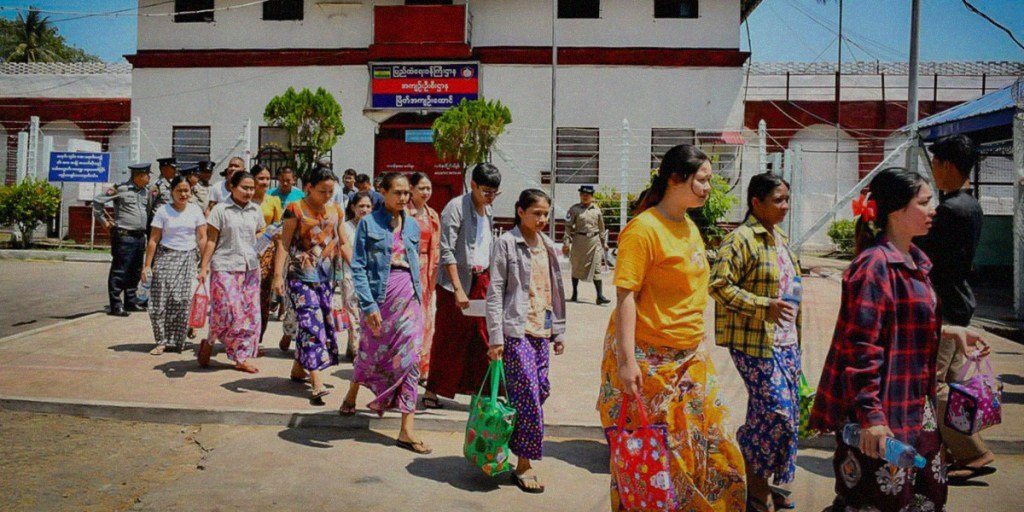
“Given the political changes, it seems deliberate. I don’t think the junta would release political prisoners without a purpose. Before the end of 2025, there were amnesties on November 26th and 27th, and another on December 1st. After those, we observed releases in preparation for upcoming elections. Now, as the parliament convenes, it appears they are releasing more people to increase the numbers,” said Ko Taik Htun Oo of PPNM.
Although political prisoners are being released under amnesty, those with long sentences, including Daw Aung San Suu Kyi and U Win Myint, are not included. Only prisoners with lighter sentences are part of the releases.
“People convicted of supporting, informing, or assisting armed groups are often released under these amnesties. But even among these cases, some individuals, despite being eligible, remain imprisoned,” Ko Taik Htun Oo added.
Meanwhile, the United Nations, European Union, and ASEAN countries continue to call for the release of all political prisoners, including those unjustly detained like Daw Aung San Suu Kyi and U Win Myint.
According to Nai Aue Mon, Director of the Human Rights Foundation of Monland (HURFOM), the junta is attempting to gain international and ASEAN approval and recognition through the release of political prisoners.
“There are many political prisoners who should be released. The leaders are very cautious about who they let go. They are trying to gain a good reputation and want support from the Myanmar people, international community, and ASEAN. That’s why they are doing this. Politically, they’ve been in power for five years and have held sham elections. The public and international community do not agree, but they want to be recognized positively,” he said.
Facing widespread international condemnation, the junta uses the release of political prisoners as a tool to counter global sanctions and criticism.
A former political prisoner also said the military’s actions are primarily aimed at creating a good image and convincing the international community that it is acting positively.
“We’ve been in prison ourselves. Releasing political prisoners is more about manipulating public perception. They release people convicted of minor offenses such as theft, gambling, curfew violations, or drug use. Those released serve only three to six months. It’s called an amnesty to create a good image internationally,” he said.
According to the Assistance Association for Political Prisoners (AAPP), a total of 30,543 individuals were arrested in connection with the military takeover, of whom 22,772 are still detained, while 11,536 have received prison sentences.
Although the release of political prisoners brings immense joy to their families, from a political perspective, it may simply be a carefully orchestrated maneuver by the junta, requiring continued observation and scrutiny.