Following the implementation of elections, Myanmar’s military has moved swiftly to roll out what it describes as its next step—peace talks.
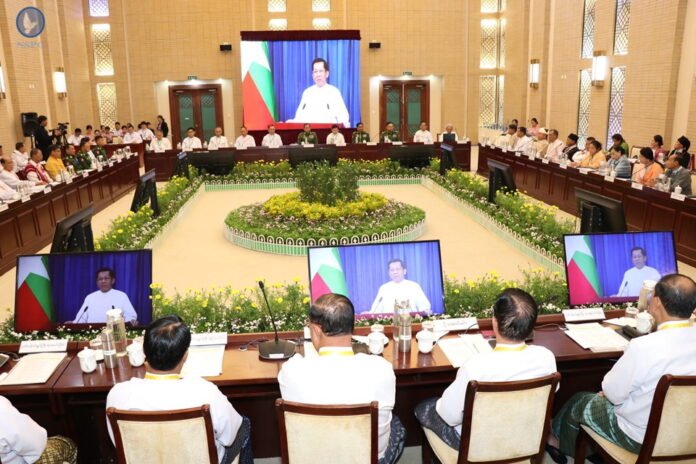
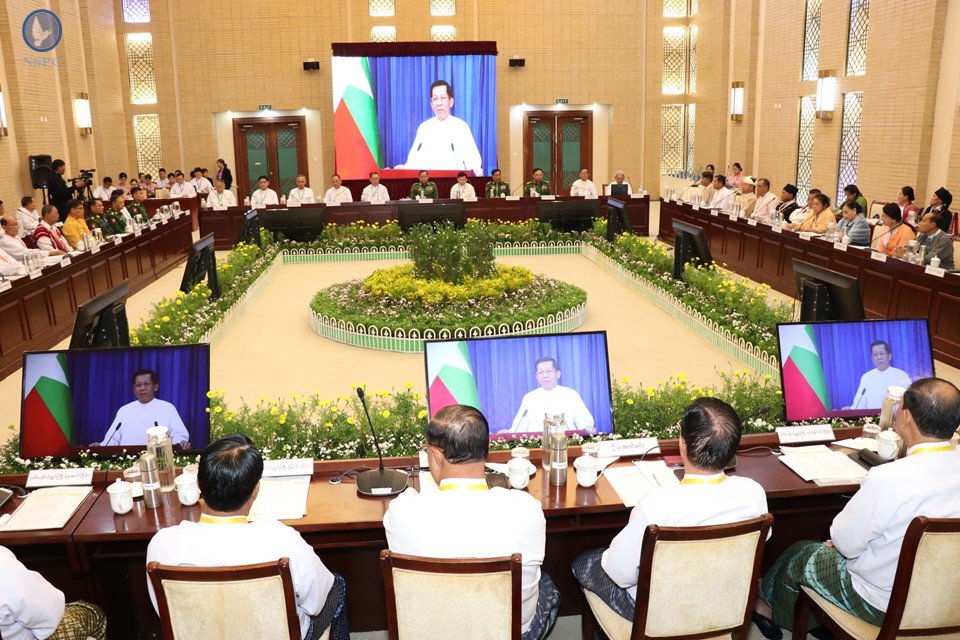
After the Union Day ceremony held in Naypyidaw on February 12th, a meeting took place between the NCA-signatory 7 EAO Alliance and the National Solidarity and Peace Negotiation Committee (NSPNC) led by Deputy Senior General Yar Pyae.
Participants in the meeting included representatives from the Restoration Council of Shan State (RCSS), the Arakan Liberation Party (ALP), the KNU/KNLA Peace Council, the Lahu Democratic Union (LDU), the Democratic Karen Buddhist Army (DKBA), and the New Mon State Party (NMSP). According to one attendee, the talks were intended as preliminary discussions on peace initiatives to be pursued by the upcoming new government.
However, since these groups are not currently engaged in active fighting with the military following the coup, questions have arisen as to whether the military’s proposed peace process will be inclusive of all stakeholders.
“What they are talking about now is dialogue—but I hesitate to call it peace,” said U Aung San Myint, Secretary of the Karenni National Progressive Party (KNPP). “Without basing it on the NCA and without reflecting the current revolutionary landscape, only an all-inclusive political dialogue can bring genuine peace to our country. What they are doing now raises serious questions about representation. If we truly want peace, the dialogue must not be based on the 2008 Constitution. The military is seeking political legitimacy and an exit strategy, especially internationally. Under these conditions, real political change and genuine peace are unlikely.”
The KNPP’s armed wing, the Karenni Army (KA), is currently one of the ethnic forces actively fighting against the junta in Karenni State and has carried out town-seizure operations.
According to sources within the 7 EAO Alliance, the military plans to prioritize talks with ceasefire groups first, before gradually inviting other armed organizations to discussions.
Although the military and the 7 EAO Alliance continue to uphold the Nationwide Ceasefire Agreement (NCA), the Karen National Union (KNU), the All Burma Students’ Democratic Front (ABSDF), and the Chin National Front (CNF) have declared the NCA null and void.
A CNF spokesperson, Salai Htet Ni, also commented that the NCA is no longer workable for contemporary peace processes.
“We have no trust whatsoever in the actions of the State Administration Council operating under the 2008 Constitution,” he said. “We engaged in political dialogue under that framework before the coup, and we see no change now. Our political aspirations continue to be ignored. As long as the military prioritizes its long-term political survival, we see no basis for peace talks today. We will continue according to our own position.”
Since the coup, numerous events labeled as “peace talks” have been held in Naypyidaw, yet the military has failed to gain the trust of ethnic armed organizations.
In particular, just as peace processes were gaining momentum under the administration of the National League for Democracy (NLD), the military’s renewed seizure of power triggered the emergence of many new armed resistance groups.
As the military revises its approach to dialogue, ethnic armed organizations have also been strengthening unity among themselves.
“We have clearly told the Naypyidaw authorities that talking only to the KIO will not resolve anything,” said Lieutenant General Gun Maw, Vice Chairman of the Kachin Independence Council (KIC), during an online speech marking the 65th anniversary of the Kachin Revolution. “We have asked whether Naypyidaw is willing to talk to the NUG. The KIO will not accept one-on-one talks. We have already conveyed this position to the international community and neighboring countries.”
Amid the Spring Revolution, the military has suffered historic losses, relinquishing control of up to 90 towns. In Rakhine State, it reportedly retains control over only three towns, while the Arakan Army (AA) holds the upper hand. Rakhine political analyst U Pha Than said the military may be forced to make concessions if it seeks negotiations with the AA.
“It’s natural to show the goods first and then see whether there are buyers,” he explained.“The military should first present a genuine federal proposal. The 2008 Constitution simply won’t work. It must be abolished and rewritten. The military may want peace, but as long as it uses the pretext of preventing national disintegration to justify perpetual rule, ethnic groups will not trust these talks. Unless the military is willing to completely withdraw from politics, these negotiations will remain purely symbolic.”
Similarly, sources say groups such as the United Wa State Army (UWSA) and the Pa-O National Army (PNA) are also seeking state-level autonomy.
Given these conditions, observers in Naypyidaw suggest the military is likely to adopt a more rigid stance and offer minimal concessions in upcoming rounds of talks.
Meanwhile, junta leader Min Aung Hlaing has stated that only when democracy is firmly established and ethnic armed organizations no longer exist would the military gradually reduce its representation in parliament.