Editorial
Let us examine the recent election conducted by the Military Commission. Ethnic forces and federal democratic groups have described the election as neither free nor fair, calling it a sham election. International organizations, including some ASEAN countries, have also pointed out that the election lacked freedom and fairness and should not have been held due to the absence of peace.
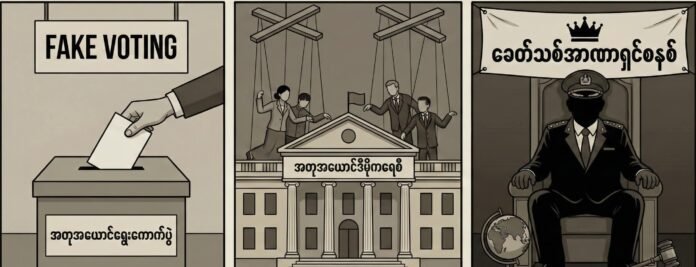
The primary objective of the election organized by the Military Commission is to repackage and preserve the Myanmar military’s grip on state power. It is intended to prevent the National League for Democracy (NLD) and ethnic political parties from regaining power. In other words, following the 2021 coup, the military has dismantled the emerging democratic system and the peace process aimed at building a federal union.
This sham election will be used to present a façade of democracy to the international community. It will give the appearance of the existence of three branches of power that are supposed to exist in a democratic system. Under the 2008 Constitution, there is a Union Parliament in which 25 percent of the seats are controlled by military representatives, while the remaining parliamentary representatives are largely former military personnel. Even the combined number of elected MPs from ethnic parties and other parties does not exceed 50 percent. As a result, the military will be able to manipulate the Union Parliament at will. Ethnic political parties will effectively become proxy political groups serving the military or the Union Solidarity and Development Party (USDP), reduced to a “go where you are told, do what you are ordered” position.
In 2026, a sham democratic system will be led by the former military-backed USDP, made up of retired military personnel who win seats through the election. However, under the 2008 Constitution, the current military dictator or coup leader, Min Aung Hlaing, could become president. Consequently, a government led by Min Aung Hlaing or another senior military general will establish a new-era authoritarian system under the guise of democracy within the framework of the 2008 Constitution.
On the international stage, such a system will receive support from authoritarian states such as Russia, North Korea, and Cambodia. Domestically, a military that has completely crushed opposing political forces and monopolized political power will not be able to establish peace. Resistance movements that believe in federal democracy will continue to fight for their objectives. As a result, genuine peace for the people of Myanmar will remain distant, and under this sham democratic, new-era authoritarian system, the country will face severe economic and social hardships. It is with deep regret that we present this reality.