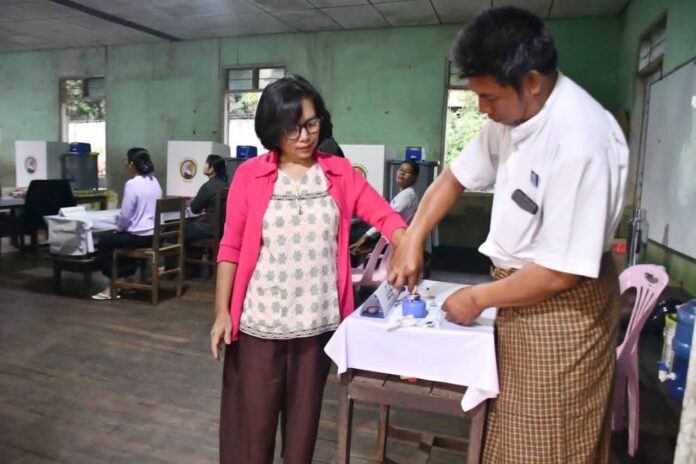
Amid ongoing armed conflict across the country, the military junta has completed the first and second phases of its general election.
According to the results released so far, the military-backed Union Solidarity and Development Party (USDP) has won the majority of seats. Other parties—including ethnic-based political parties cooperating with the military regime—have secured only a small number of seats.
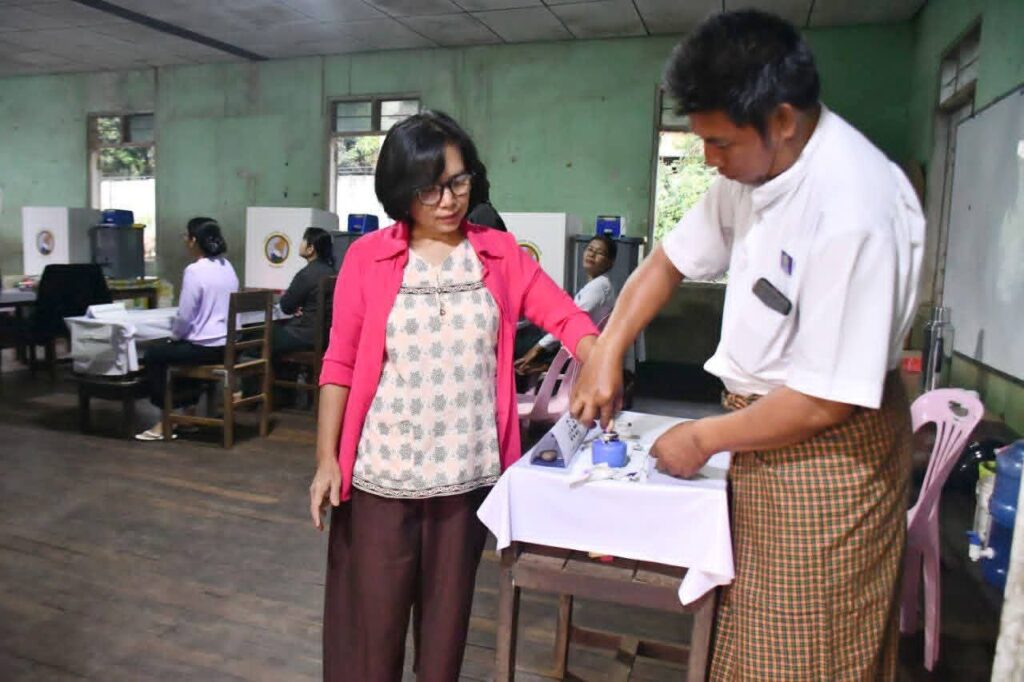
The first phase of the election was held on December 28, 2025, in Mon State’s Mawlamyine, Chaungzon, Kyaikmaraw, Thaton, and Kyaikhto townships. The second phase followed on January 11, 2026, in Mudon, Thanbyuzayat, Ye, Paung, and Bilin townships.
In both Phases 1 and 2, advance voting, ballot verification, and vote counting were carried out exclusively by members of the USDP. Representatives from other political parties were not permitted to participate in these processes.
As a result, critics have described the phased elections organized by the military commission as a sham election lacking transparency and fairness.
“Voting using a digital system may seem better than the old method, but when it comes to verifying the votes afterward, neither the public nor the candidates know how to check them or are allowed to do so. That’s something we need to seriously think about,” said a man from Mawlamyine who cast his vote.
By contrast, during the 2020 multi-party democratic general election, advance voting and vote-counting procedures were conducted by assigned teachers, youth volunteers at polling stations, as well as representatives from competing political parties, according to sources.
The military commission, which seized state power by alleging voter fraud in the 2020 election, repeatedly extended the state of emergency before eventually holding elections as a political exit strategy to govern the country.
Due to a long-standing lack of trust in the military commission’s elections, young people living abroad did not participate in advance voting, and some young people inside the country also abstained from voting, sources said.
In the 2020 election, voter turnout in Mon State was 58 percent. However, the Mon State Election Commission announced that turnout was only around 39 percent in both Phases 1 and 2 of the elections held by the military commission.
Based on voter turnout alone, it can be said that the Mon State election conducted by the military commission—carried out amid explosions and gunfire—was only partially successful.
Nevertheless, this election introduced electronic voting machines that had never before been used in Myanmar. The electoral system also combined the First-Past-the-Post (FPTP) system with Proportional Representation (PR).
“The voting area itself was a bit confusing. Since this electronic system is new, some people didn’t really understand it. The buttons were small, so people just pressed whatever they saw. There were buttons placed next to each party’s name—that’s how it looked,” said a woman voter from Thanbyuzayat Township.
Because electronic voting machines were used for the first time in Myanmar’s elections, ordinary citizens faced difficulties in using the system, she added.
Nearly five years after the coup, the military commission has held Phases 1 and of the election in 202 townships under its full control. Phase 3 is scheduled to take place on January 25 in 63 additional townships.