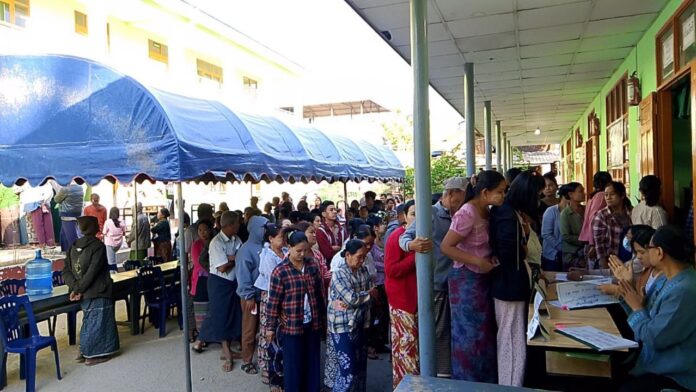
Some voters in Mon State interviewed by the Independent Mon News Agency say, they have little interest in the military junta’s parliamentary representatives. They state that these candidates do not genuinely represent the public.
Following the second phase of the election in Mon State, the State Election Commission confirmed 45 candidates for three parliamentary seats on January 12.
According to official figures, the Union Solidarity and Development Party (USDP) secured the largest number of seats with 21 representatives, followed by the Mon Unity Party with 17 seats.
Local residents said they went to polling stations not out of support for the military junta’s candidates, but due to security concerns and pressure. A resident of Thanbyuzayat Township said voters were more focused on personal safety than on the candidates themselves.
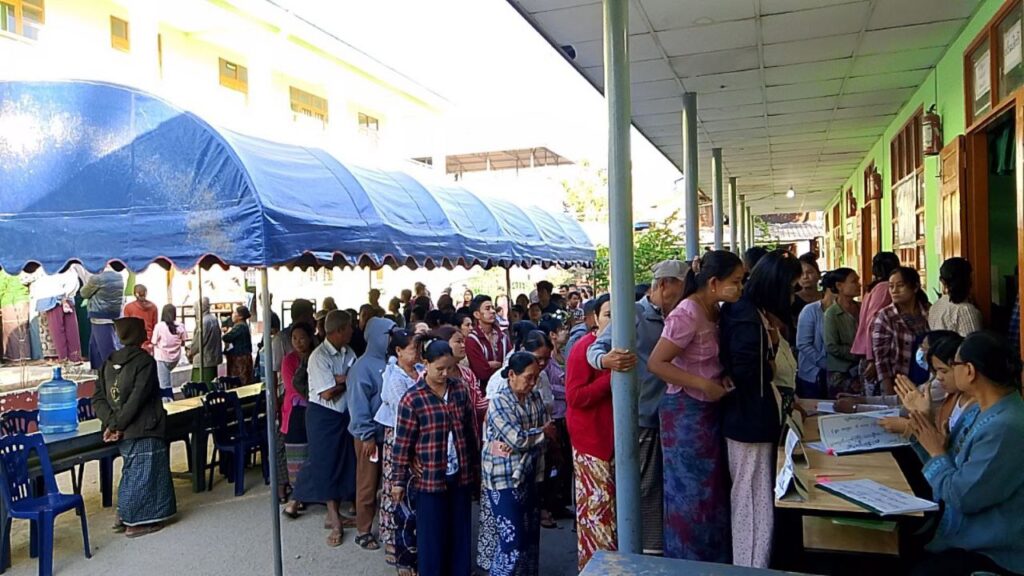
“When we went to vote, we were worried something might happen. We didn’t go because we wanted to vote. If we didn’t go, we were afraid informants would photograph us and report us. We went because we were afraid of problems,” the resident said.
The voter added that the voting process itself was unclear, making it difficult for people to fully understand how to cast their ballots, resulting in voters participating without confidence in the system.
According to the State Election Commission, results from the first and second phases of the election in Mon State showed that two seats went to the National Unity Party, one to the Pa-O National Development and Progress Party, 21 to the USDP, one to the People’s Party, one to the People’s Pioneer Party, 17 to the Mon Unity Party, and two to the National Interest and Development Party. No candidates from the Shan and Nationalities Democratic Party (White Tiger Party) won any seats.
The second phase of the election in Mon State saw more violence than the first phase. In the days leading up to and including election day, at least four armed clashes occurred between military junta forces and resistance groups in Ye and Mudon townships, along with eight explosions.
Local residents reported that on January 10th at around 1 p.m., a drone-delivered explosive struck a house in Thein Gone Ward, Ka Mar Wet town, killing an 80-year-old woman.
“The house was close to a high school where voting was taking place. Resistance groups were using drones to drop explosives. She was alone at home and was hit,” a Ka Mar Wet resident said, adding that other family members were away.
Despite the violence, the State Election Commission announced that voter turnout in the five townships involved in the second phase of the election was 39.36 percent.
Junta spokesperson, Major General Zaw Min Tun stated at a media briefing held on January 11th, that parliament will be convened in March, with a new government expected to assume duties in April.
Meanwhile, reports from military-linked channels suggest that leadership changes are expected within the armed forces after the election, with indications that the military leadership will continue to consolidate power under the new political arrangement.