As major world powers step up parallel enforcement actions against cyber scam operations along the Thai–Myanmar border, the military regime and local armed groups—accused of indirectly supporting these operations—have publicly denied involvement and claimed they are carrying out crackdowns.
However, according to border-area sources, the initial enablers that allowed cyber scam operations to take root and enabled foreign nationals to enter and reside in these areas included the military regime, as well as local ethnic armed organizations and the BGF/KNA, who reportedly provided assistance.
Following international announcements pledging action against cyber scam networks, the BGF/KNA and DKBA have reportedly joined in symbolic arrest operations. At the same time, sources close to armed groups say these same organizations are providing safe housing and buildings as shelters for scam operators.
Residents of Three Pagodas Pass town report that since December 8, the DKBA and KNU have jointly imposed strict inspections, barring Chinese nationals and other foreigners linked to cyber scams from entering or leaving the town.
Sources close to armed groups say these measures are merely performative. Outside Three Pagodas Pass, in newly constructed buildings erected by armed groups, the number of cyber scam leaders and workers has reportedly increased beyond previous levels.
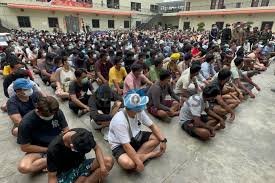
“They make announcements just to protect their group’s image. Day and night, DKBA and KNU patrol with about seven or eight vehicles, claiming they are preventing Chinese nationals from entering and will arrest those transporting them. They wait at checkpoints near the hospital junction and the high school junction. But these restrictions are only for show—cyber scam operations are still ongoing. I can’t give exact numbers in Three Pagodas Pass, but outside the town, they are still active, and large-scale construction is underway,” a source said.
It is also understood that the DKBA and KNU have jointly announced that anyone found harboring or assisting Chinese nationals could face up to two years in prison.
In recent days, Chinese nationals have been increasingly seen entering and exiting high-end hotels in Mawlamyine. Others currently in Hpa-An are reportedly relocating to areas where scam operations are active, according to a Myawaddy-based driver.
While the military council has been arresting cyber scam workers at checkpoints along the Salween Bridge, Thaton–Hpa-An Road, and Thaton–Kyaikhto Road, it is also reported that transportation to Yangon—from Hpa-An to Phyar Kyi—continues with the assistance of police and military units, at a rate of two million kyats per person.
In Myawaddy Township, Karen State, within the KK Park cyber scam compound in the Mae Htaw Thalay area, the military regime demolished 246 buildings starting from the last week of November.
Since early December, non-local residents entering Shwe Kokko in Myawaddy Township have reportedly been required to carry residency cards issued by the BGF/KNA, with tightened inspections at town entry and exit points, according to a local resident.
“Except for the staged demolitions, the towns are functioning as usual. Only outsiders are restricted. In fact, controls are even tighter now. The BGF/KNA issues residency cards—guests must have them. Scam sites are still operating normally, and there are also newly constructed sites,” the resident said.
In addition to symbolic demolitions, reports indicate that the BGF/KNA itself is leading the rapid construction of new cyber scam city projects around Thit Kadeh village near the Dawna mountain foothills. It is also reported that the military council has directly authorized relocation processes.
Observers monitoring cyber scam operations say that since the crackdown is only temporary, displaced scam workers scattered across various areas have no plans to start other businesses and will resume online fraud operations depending on circumstances.
According to Justice for Myanmar (JFM), there are up to 42 cyber scam camps along the Thaungyin River, stretching from Shwe Kokko north of Myawaddy to Waw Lay Myaing in the south.
JFM’s March 2025 report and information from the Cyber Scam Monitor website also indicate that, in addition to KK Park 1, 2, 3, and 4, many other compounds—such as Dong Mei Park, Apollo Park, and Yulong Bay—remain in operation.
Meanwhile, at an MRTV press conference on December 15, Military Council spokesperson Major General Zaw Min Tun accused the Karen National Union (KNU) and its affiliates of accepting payments to protect online scam operations in Karen State.
However, the U.S. Department of the Treasury has stated that the main perpetrators behind cyber scam operations are the Myanmar military and the BGF/KNA and that sanctions have been imposed in connection with cybersecurity-related offenses.
Written by Kanyan.